

A mother called me last spring with a plan she’d already worked out on a legal pad. She’d sell her son the house for what she still owed, roughly a third of what the place was worth, and everybody walks away happy. Her accountant thought so too.
You can absolutely sell a house to your son for less than it’s worth in Tennessee. The discount you hand a family member doesn’t disappear into thin air, though. It gets reclassified, taxed differently, and sometimes it reappears years later in a Medicaid application or an estate fight among siblings.
Can I Sell My House to My Son Below Market Value in Tennessee?
Parents picture a clean handoff: sign a deed, hand over the keys, call it a bargain sale between two consenting adults. Tennessee law allows exactly that. The plan trips up at the IRS, which treats the gap between your sale price and true market value as a gift, whether or not you ever use that word.
Say your house appraises at $300,000 and your son pays $180,000. Federal tax law sees that $120,000 spread as a gift from you to him. It still counts.

Tennessee itself doesn’t charge a state gift tax, and the state has no income tax on wages or capital gains either. That’s a genuine advantage over selling to a family member in, say, Connecticut.
A while back I worked with a family who wanted to pass the parents’ ranch house to their son at a steep discount. A contractor’s estimate to redo the kitchen came in higher than the kitchen itself would’ve added to the appraised value, which changed the whole math on what “below market value” even meant for them.
Statewide, Tennessee’s median sale price sat at $373,833 in September 2026, down a hair (0.31 percent) from a year earlier, according to Redfin’s Tennessee market data. Homes across Tennessee took a median of 68 days to sell that month. Those numbers matter because a below-market sale to a family member still needs a defensible value behind it, and a cooling market gives you more room to argue a lower number honestly.
What Is a Non-arm's Length Transaction Between Family Members?
Picture a father selling his rental house to his daughter at a price well below what a stranger would pay. Non-arm’s length is how the title company flags this. Nothing sinister. It’s a label for any sale where buyer and seller have a pre-existing relationship that could influence the price.
An arm’s length transaction happens between strangers, each pushing for their own interest. Sell to your son, your daughter-in-law, your business partner, or your tenant of fifteen years, and underwriters flip a different switch.
Mortgage underwriting is usually where a family member sale hits its first wall, since his lender will want the discount documented as a gift of equity. This requires a letter, an appraisal, and sometimes a seasoning period before he can refinance. Some loan programs cap how much gift of equity counts toward the down payment. Others forbid certain non-arm’s length combinations outright, like an investor buying from a family member who still occupies the home.
Appraisers in Tennessee markets will often note a non-arm’s length sale in their comparable analysis and exclude it. That’s why your below-market sale to a family member usually won’t drag down the neighbors’ values; the data gets flagged.
Tennessee also builds a safeguard into the deed itself: when a warranty deed is recorded, somebody swears under oath to the actual consideration or the property’s value, whichever is greater. Lying on it is a real problem, and the state actively compares sworn deed values against assessor records.
Why Does Tennessee Scrutinize Below Market Value Sales to Family?
“It’s my house, I can sell it for a dollar if I want.” The catch is that Tennessee collects a recordation tax on the transfer. The state calculates it on the greater of what was paid or what the property was worth. Selling a family member your home for a dollar doesn’t produce a one-cent tax bill.
Under Tenn. Code Ann. § 67-4-409, the realty transfer tax runs 37 cents per $100 of that value, and the register won’t record the transfer until it’s paid.
The Tennessee Department of Revenue’s guidance confirms the same rate and the same “greater of” rule.
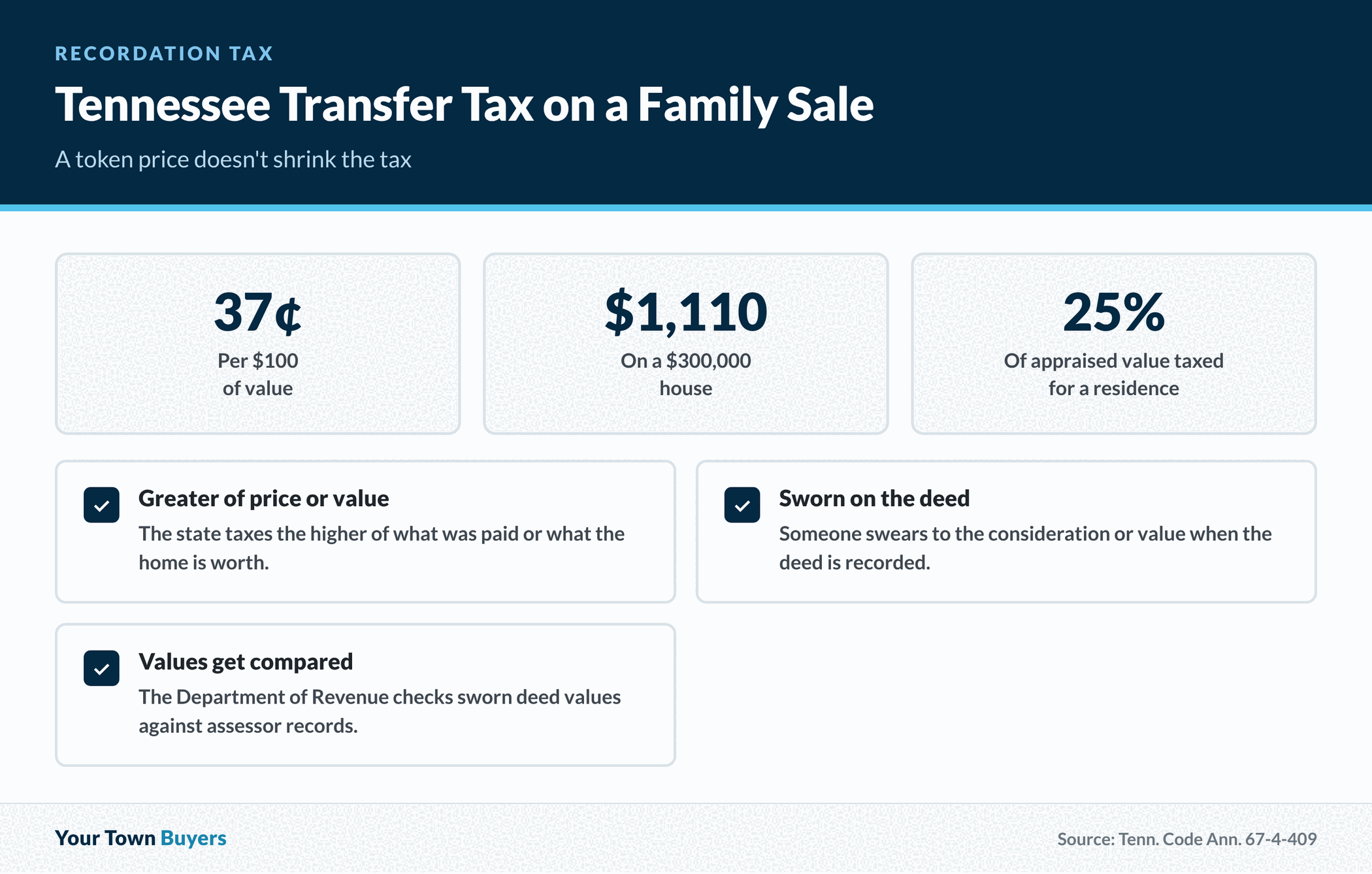
The Department runs a discovery program comparing values sworn on recorded deeds against the assessor’s figures, and mismatches can trigger an inquiry letter to the owner named on the deed.
Property assessment is the second reason Tennessee pays attention. Your county assessor values the home independently of what your family member paid, and Tennessee taxes residential property on 25 percent of appraised value. A bargain price to your son won’t lower his tax bill.
A quieter reason exists too, and it has nothing to do with revenue. Below-market family transfers are a known pattern in elder financial exploitation cases. Most of them are legitimate. A few are not. That’s part of why a Tennessee attorney will ask your parent questions privately before a deed gets signed, and frankly, that’s a protection worth having rather than resenting.
Should I Gift the House to My Son Instead of Selling Below Market Value?
That raises the obvious follow-up: if the discount counts as a gift anyway, why bother with a sale price at all?
Sometimes you shouldn’t. An outright gift to a family member is cleaner in paperwork terms. The federal annual exclusion sits at $19,000 per recipient for 2026, unchanged from the prior year. The lifetime exemption is $15 million per person after the One Big Beautiful Bill Act made it permanent, per Morgan Lewis’s summary of the IRS announcement. Go over the annual number and you file Form 709; you almost certainly owe nothing.
Give your son the house outright and he inherits your cost basis, meaning the price you paid plus improvements. Sell it below market and his basis is generally what he paid, with gift rules layered on top.
The step-up in basis at death is the single most expensive thing families give away without noticing. A Tennessee home bought in 1988 for $62,000 and worth $340,000 today carries a huge embedded gain. Die owning it and your heir’s basis resets to market value, so the gain evaporates. Transfer it during your life and that gain rides along to your son.
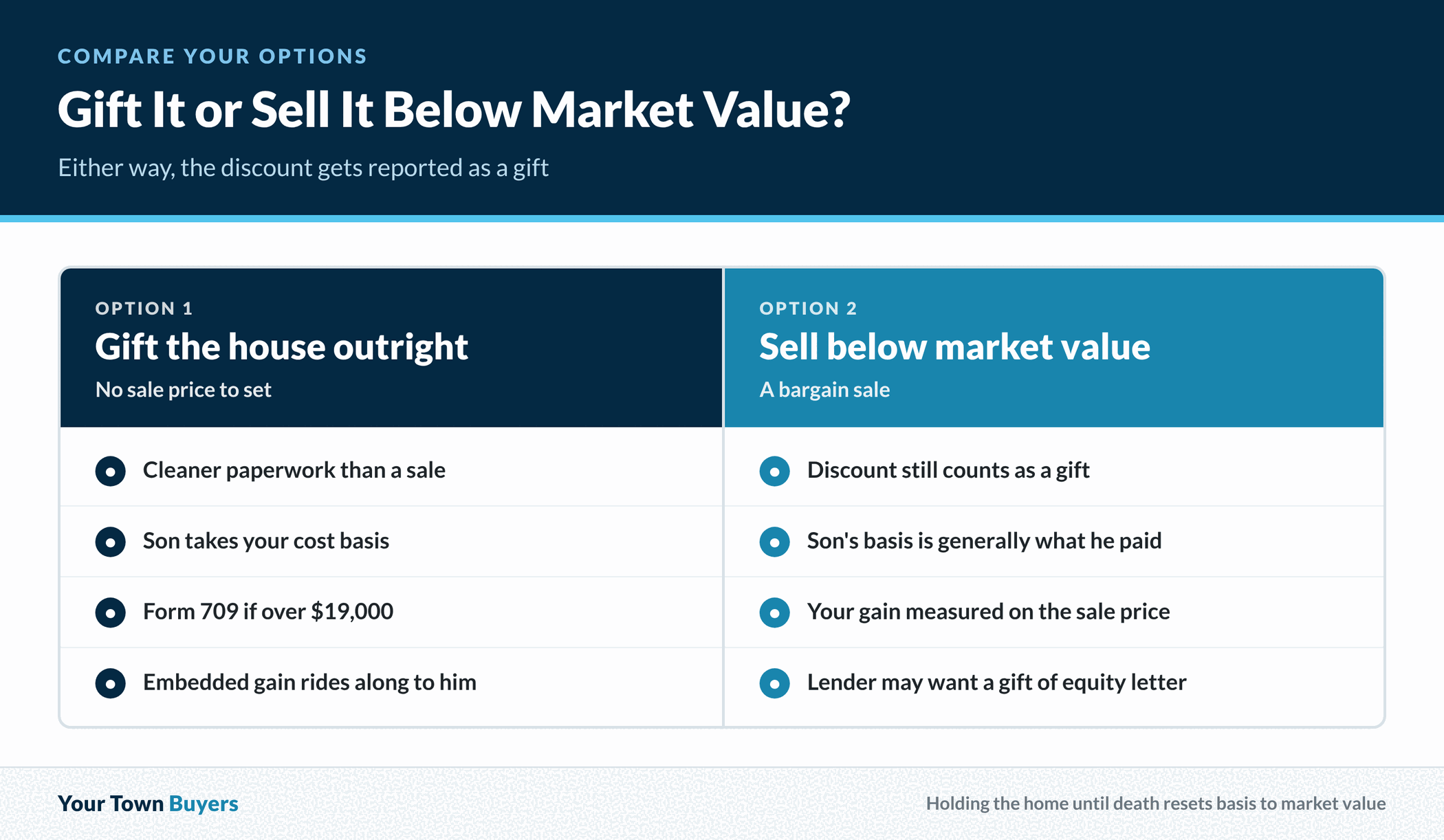
Here’s my opinion, stated plainly. If your estate is nowhere near the federal exemption and you only want the house to reach your son eventually, a lifetime transfer to a family member is usually the worse move. A transfer-on-death arrangement or a trust often gets you the same outcome but with better tax treatment. Talk to a Tennessee estate attorney before you sign anything.
Medicaid changes the calculus again. Transferring property to a family member for less than fair market value can create a penalty period if long-term care comes up within the lookback window.
What Taxes Apply When Selling a House Below Market Value to a Son?
Let me put it the way I’d say it across your kitchen table: three different tax systems look at this transfer, and they don’t talk to each other.
Capital gains come first. Your gain is measured against what the property sold for, not what it was worth, which means a discounted sale to a family member shrinks your taxable gain. Per IRS Topic 701, you can exclude up to $250,000 of gain on your main home, or $500,000 filing jointly. You need to have owned and lived in it at least two of the five years before the sale. You also can’t have used the exclusion on another home within the prior two years.
Most Tennessee sellers clear that bar easily and owe nothing federally.
Gift tax reporting is the second system. The discount to your family member gets reported, your lifetime exemption absorbs it, and life goes on.
Recordation tax is the third, and your son as grantee is the one the Department of Revenue looks to for payment. On most Tennessee transfers it’s a modest line item. At that rate, the $300,000 house from earlier would carry a transfer tax of $1,110.
One wrinkle worth flagging. Losses on sales to related parties are generally disallowed under federal law, so don’t plan on harvesting a tax loss by selling your house cheap to a family member.
What Are the Risks and Benefits of Selling to a Family Member?
A $150,000 house sold to your son for $90,000 can trigger scrutiny years later. Title insurance underwriters sometimes treat a recent below-market family transfer as a fraudulent-conveyance risk. This can complicate your son’s ability to sell or refinance for a period afterward.
Your exposure to creditors is the related worry. If you owe money and transfer a valuable asset to a family member for far less than it’s worth, a creditor can argue the transfer was made to put the asset out of reach. Solvency at the time of transfer matters enormously here, so a Tennessee attorney should document it properly.
Siblings are the other risk, and it’s the one I see most often. The brother who didn’t get a discounted house remembers. Twenty years of Thanksgivings can sour over a deed, especially when nobody wrote down why the arrangement made sense.
You skip agent commissions on both sides. Your family member gets instant equity, which can mean a smaller loan, no mortgage insurance, and a payment they can actually carry. In a market where 21.9 percent of Tennessee homes took price cuts in September 2026, that kind of certainty has real value.
Have you thought about what happens if your son’s marriage ends? A house transferred at a discount can become marital property depending on how it’s titled and what gets commingled.
Selling to a family member means the roof and the HVAC become his problem with no inspection contingency and no negotiation. Knowing what you’re handing someone is a kindness, not a formality.
How Do I Prepare to Sell My Home to a Family Member?
For years I told sellers an appraisal was optional on a family sale, and I was wrong about that. It’s the cheapest insurance in the whole transaction.
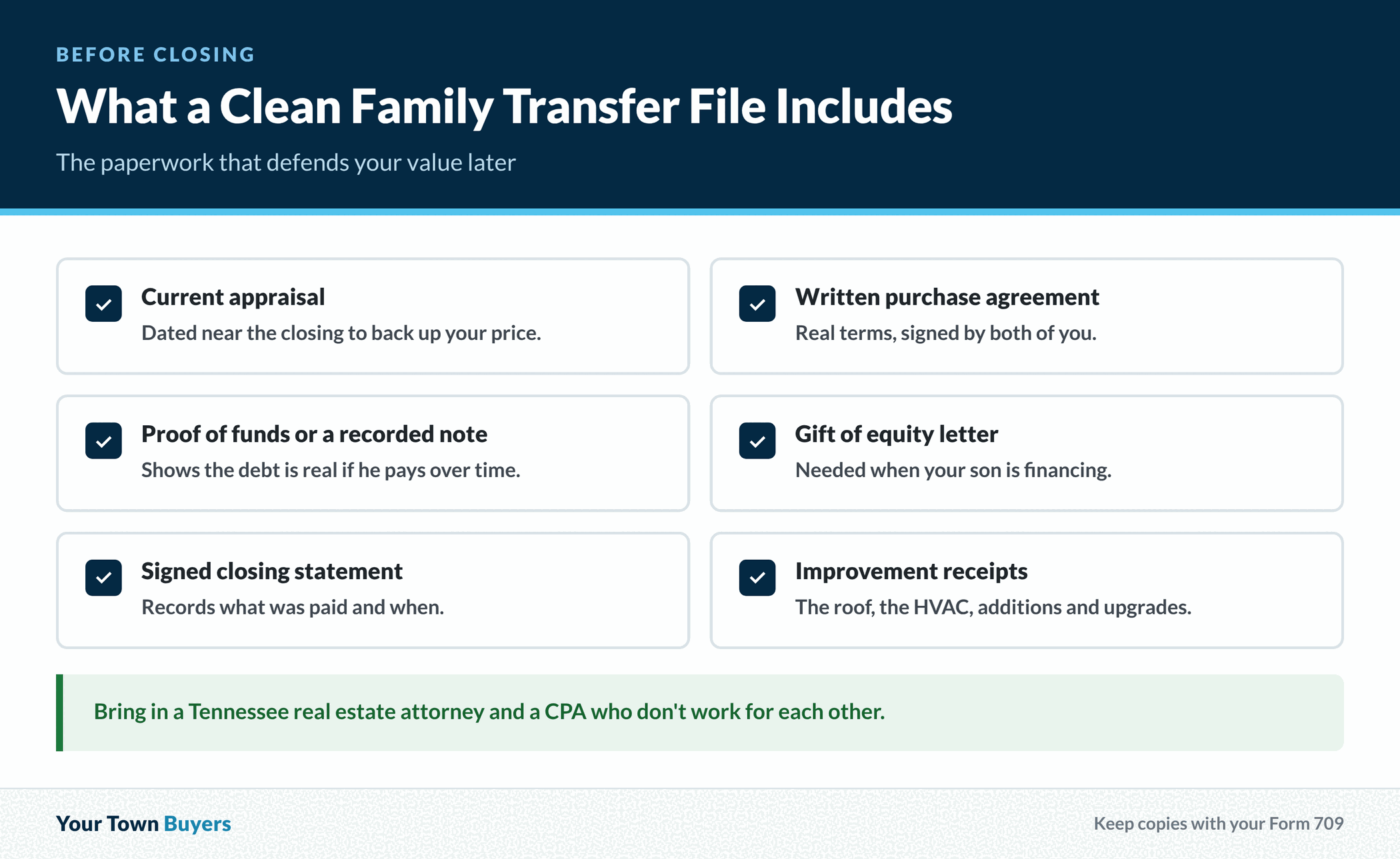
Order a licensed appraisal before you set a price. A written opinion of fair market value, dated near the closing, is what defends your Form 709, your deed oath, and your position if anyone ever questions the transfer.
Gather receipts going back years: the 2011 roof, the addition, the HVAC replacement, the deck.
Then bring in two professionals who don’t work for each other: a real estate attorney licensed in Tennessee and a CPA. Paying a lawyer to draft the deed and handle the recordation correctly costs a fraction of fixing a bad deed later.
A clean file for a family member transfer looks like this: a current appraisal, a written purchase agreement with real terms, proof of funds or a recorded note. It also includes a gift of equity letter if financing is involved, and a signed closing statement.
Where does your son’s financing stand? Get him pre-approved before you agree on a price, because his lender’s rules on non-arm’s length financing may dictate the structure more than your preferences do.
How Do I Keep a Family Home Transfer Smooth and Tax-compliant?
What’s the best way to avoid disputes down the road? Write it all down, even when it feels insulting to your own family.
Put the price, the terms, the responsibility for taxes and insurance, and the timeline in a signed agreement. If your son is paying you over time, record a deed of trust so the debt is real and visible.
Report the gift portion the year you make it. Filing Form 709 late is a nuisance you don’t need, and the return is what establishes the value if anyone revisits the transfer a decade from now.
Watch the timing against your own retirement plan. If you still need the house’s equity to fund your later years, a deep discount to a family member may leave you short. I’ve watched parents transfer a Tennessee home to a child and then struggle with assisted living costs they hadn’t modeled.
Not every family has the luxury of a slow, orderly transfer. A homeowner reached out while three months behind on the mortgage with an auction date already on the calendar. He was hoping to deed the place to his son so the son could catch up the payments. The lender wanted the full arrearage, not a new owner, and the garage was still packed with his late father’s woodworking equipment.
When the clock is that tight, a below-market sale to a family member usually isn’t fast enough to help. Lenders and underwriters need weeks. If you’re facing a deadline, talk to someone who can close on a certain date. The team at Your Town Buyers handles Tennessee properties in as-is condition and can tell you honestly whether a direct sale or a family transfer serves you better.
Frequently Asked Questions
Can I Legally Sell My House to My Son for One Dollar in Tennessee?
You can sign that deed, but the state calculates its recording tax on the property’s value rather than the token price, so a dollar doesn’t produce a dollar’s worth of tax. The difference between the dollar and what the house is worth also counts as a reportable gift federally. Most Tennessee attorneys will steer you toward a documented bargain sale or a proper gift deed instead, because both create a cleaner record.
Will My Son Have to Pay Taxes on the Discount He Receives?
The recipient of a gift doesn’t pay federal gift tax; that obligation sits with the giver, and in practice it almost never results in an actual bill. Your son will owe the recordation tax as the grantee, and he’ll pick up Tennessee property taxes going forward based on the county assessor’s value, not his purchase price. His bigger concern is basis, since buying at a discount from a family member can leave him with a larger taxable gain whenever he eventually sells.
Does Tennessee Charge Its Own Gift Tax or Inheritance Tax on a Family Transfer?
Tennessee repealed both, so a transfer to a family member doesn’t face a state-level gift or inheritance tax. The federal gift reporting rules still apply, and the state recordation tax still gets collected at the register’s office. Your county register of deeds can confirm current recording fees for your specific paperwork.
Can My Son Get a Mortgage to Buy My House Below Market Value?
Often yes, through what lenders call a gift of equity, where your discount functions as his down payment. His lender will require an appraisal, a signed letter from you explaining the arrangement with a family member, and sometimes a waiting period before he can refinance. Loan programs vary quite a bit on this point, so have him talk to a Tennessee loan officer before you agree on a number.
Should I Use a Quitclaim Deed to Transfer the House to My Son?
I’d generally avoid it for a family member transfer unless an attorney specifically recommends one. A quitclaim passes along whatever interest you have without warranting clear title, which can create title insurance headaches for your son later. A warranty deed prepared by a Tennessee attorney costs a little more and protects the person you’re trying to help.
What If My Son Wants to Buy the House but I Still Owe a Mortgage?
Your existing loan almost certainly contains a due-on-sale clause, meaning the balance comes due when title transfers. Some Tennessee families handle this by having the son obtain his own financing to pay off your loan at closing, and others negotiate directly with the servicer. Don’t just hand over the deed and keep making payments; that arrangement leaves both of you exposed.
Is Selling to a Family Member Faster Than Listing on the Open Market?
Usually, since you skip showings, marketing, and buyer negotiations entirely. Financing is what sets the real pace, and an underwriter reviewing a non-arm’s length file in Tennessee may take longer than a routine closing. A cash family member can close in a couple of weeks; a financed one should plan on the normal loan timeline or a bit more.
If you’re weighing a below-market sale to your son against listing, we’re glad to talk it through. The same goes if you just want a straight answer on what your Tennessee house would bring in its current condition. No pressure, no obligation, and no hard feelings if you decide the family route is the right one.
Family Sales and the Memphis Market
If the house you’re thinking of passing to your son sits in the Memphis area, the appraisal will reflect a softer market. Zillow’s home value index put the typical Memphis home at $151,794 through September 2026, about 2.8% lower than a year before.
Your Town Buyers works with families across the metro, including homeowners in Bartlett, TN.
We also buy houses in Germantown, TN, so you can compare a family sale with a cash offer before you decide.
Compare a Family Sale With a Cash Offer
Some parents decide the house should go to their son. Others find a direct sale fits better, especially when repairs or timing get in the way. If you’d like a number to compare, you can contact Your Town Buyers or fill out the form below. We’ll give you an honest answer and leave the choice with you.
Helpful Tennessee Blog Articles
- How to Sell a House Without a Realtor in Tennessee
- Selling a Probate House in Tennessee
- How to Sell a House with Delinquent Property Taxes in Tennessee
- How to Sell a House with a Mortgage in Tennessee
- Selling a House in Foreclosure in Tennessee
- Selling a House During Divorce in Tennessee
- How Long Does an Eviction Process Take in Tennessee
- Appraisal Required Repairs in Tennessee
- How Much Do Realtors Charge to Sell a House in Tennessee
- How to File a Quitclaim Deed in Tennessee
- How Much Does It Cost to Stage a House in Tennessee
- How to Sell a Tennessee House without Repairs
- How to Sell Your House and Relocate Out of State
- Required Paperwork for Selling an Inherited House in Tennessee
- Can an HOA Foreclose on Your Home

Get Your Cash Offer And Sell Your House Without An Agent Today
Fill out the quick form below or call us at (901) 675-8005 to get an offer on your house TODAY!
"*" indicates required fields