

A hairline crack in a Murfreesboro crawl space wall cost one seller nothing. Another seller two counties over watched a buyer walk at day 52 over the same width of crack, because nobody had a report explaining it. Same crack, yet the outcome couldn’t have been more different. In my experience, the gap between a documented issue and an unexplained one decides most sales involving foundation problems in Tennessee.
What Causes Foundation Problems in Tennessee Homes?
Usually, it’s the dirt underneath the house.
Some of the busiest soil in the Southeast is beneath Tennessee. Expansive soils and swelling clays contain minerals that expand once they get wet. Then they shrink back when a dry August hits. So the ground beneath a house is never really standing still. That cycle pushes and releases, pushes and releases, season after season. A footing riding on clay that moves is a footing that eventually cracks.
Karst landscapes show up across much of East Tennessee, and the Tennessee Department of Environment and Conservation’s geology division describes how soluble bedrock creates voids below the surface. A house above one of those voids settles unevenly, and the drywall tells on it first.
Regional patterns matter when you’re explaining foundation problems to a local buyer. Out west, around Memphis, clay swells and contracts with moisture. That’s why builders there lean on deeper footings or reinforced slabs. The middle of the state carries limestone karst terrain with hidden sinkholes that can call for specialized footings or piers. Knoxville and the Tri-Cities add hillside lots and shallow rock into the mix.
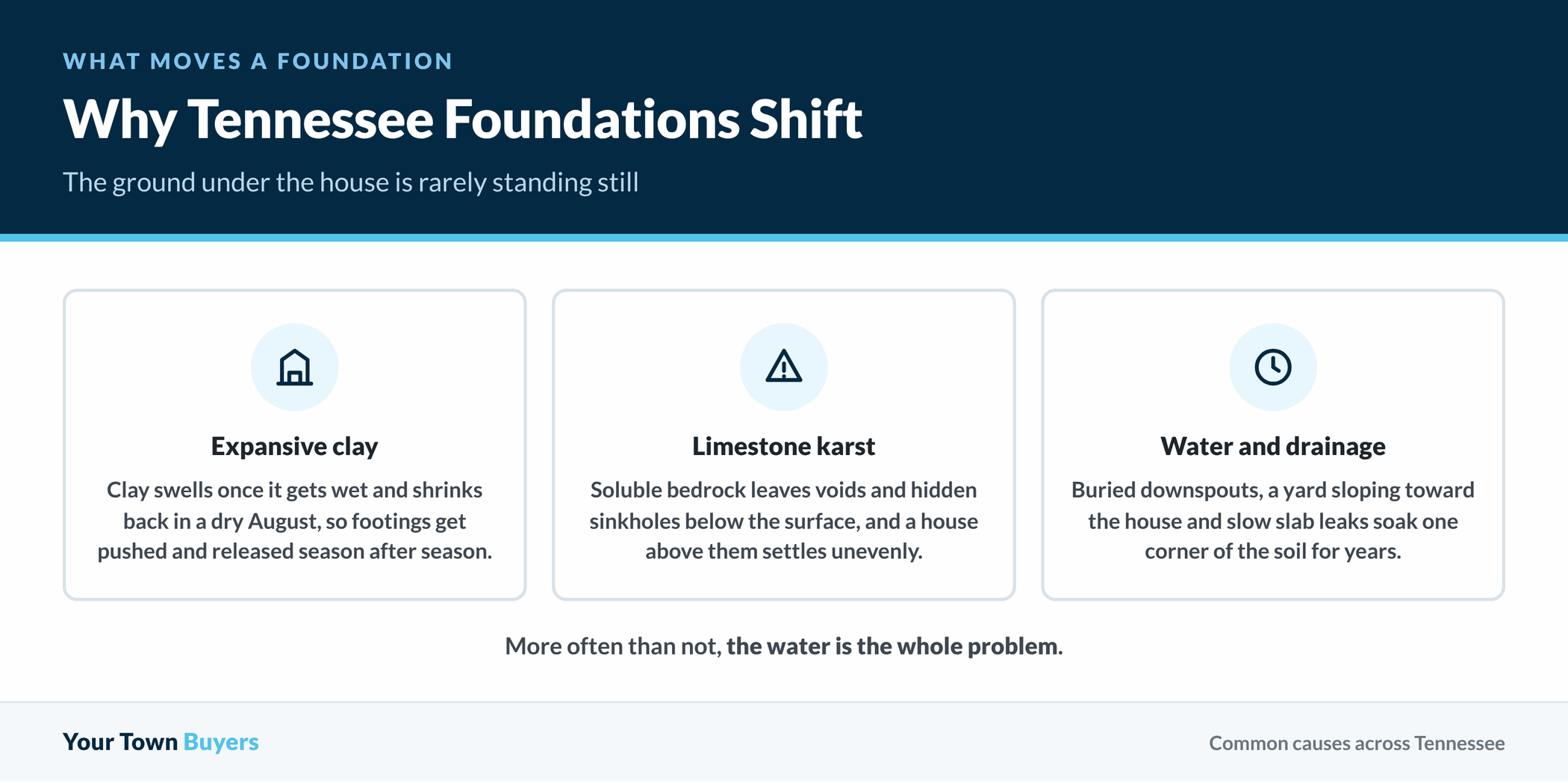
A slow leak under a slab saturates one corner of the soil for years before anyone notices the wet spot. Gutters dumping water against one wall will do the same thing on a slower schedule.
Nearly every Tennessee home I’ve walked with suspected foundation problems had a drainage story attached. I’ve seen a downspout buried in mulch, a yard that sloped toward the house, and a crawl space vent with standing water three feet inside. More often than not, the water was the whole problem.
What Are the Warning Signs of Foundation Problems in a Tennessee Home?
A seller in East Nashville called me about a sticking back door, convinced the humidity was to blame. We found the real story in the basement corner, where a stair-step crack ran through three courses of block.
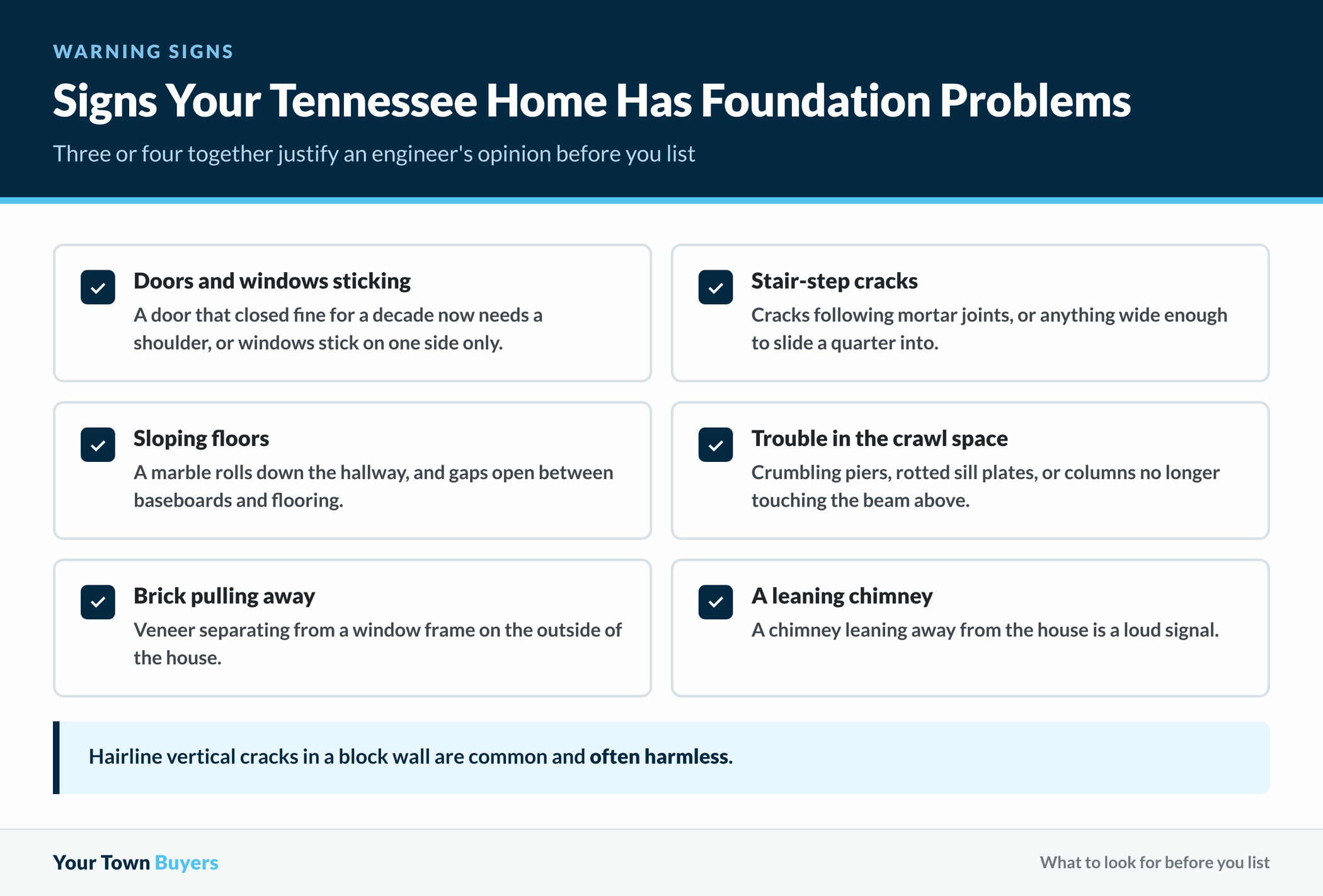
Doors tell you first. When one that closed fine for a decade suddenly needs a shoulder, something moved. Windows that stick on one side of the house but not the other point the same direction.
Hairline vertical cracks in a block wall are common across Tennessee and often harmless. Cracks that follow the mortar joints in a staircase pattern, or anything you can slide a quarter into, carry more weight with inspectors and lenders.
Set a marble down in the hallway of a 1960s ranch in Chattanooga’s North Shore and watch where it goes. Gaps opening between baseboards and flooring, or crown molding pulling away from the ceiling, belong in the same category.
You’ll find the clearest evidence of foundation problems in Tennessee houses hiding in crawl spaces. Crumbling piers, rotted sill plates, columns that no longer touch the beam above them: those tell you the structure has shifted. Bring a flashlight and look at where wood meets masonry.
Not long ago an out-of-state heir called me about a brick ranch in Bartlett, just outside Memphis. She’d inherited half the house from her uncle, and her cousin owned the rest. She had no interest in flying back to handle a bowing basement wall and a garage full of his fishing gear. All she wanted was the sale handled, and that’s what we did.
Outside, check whether the brick veneer has separated from a window frame. Chimneys leaning away from the house are a loud signal. None of these mean disaster by themselves. Spot three or four together in one Tennessee home, though, and that justifies an engineer’s opinion before you list.
How Do Foundation Problems Affect Your Home's Sale Price in Tennessee?
Pretend the cracks aren’t there when you set the number, and you’ll spend six weeks collecting showings that go nowhere. Then you’ll cut the price anyway after an inspection kills your first contract.
Buyers discount structural uncertainty far harder than they discount a known repair. Getting ahead of the question pays off. Hand over a $6,000 estimate from a licensed contractor, and your negotiation exposure shrinks to roughly that number plus a little buyer anxiety. No estimate at all, and buyers invent their own number, usually five times too high.
This market has real money at stake. In October 2026, homes here sold at a median price of $373,435, down a fraction of a percent from the previous year. Median time on market statewide was 66 days. A 10 percent structural discount on a median house here is close to $37,000, which dwarfs most actual repair bills.
Repair costs swing widely. National data for 2026 puts the average foundation repair around $4,850, with the middle 60 percent of invoices landing between $2,300 and $7,100. Published cost data also shows that a sealed non-structural crack is the most common outcome at $350 to $900, while piering one side of a house is the heavier job at $10,000 to $30,000.
A conventional loan can survive a documented, repaired foundation. An FHA or VA appraisal flagging active structural movement usually stops the loan cold until the work is done.
Local markets absorb these discounts differently. Buyers in Knoxville’s Fourth and Gill or Nashville’s Inglewood expect older houses with settled foundations and price accordingly. Newer suburbs in Spring Hill or Mt. Juliet produce sharper reactions, since comparable houses there have no issues at all.
What Legal Disclosures Are Required for Foundation Problems in Tennessee?
Plenty of sellers assume an as-is sale lets them stay quiet. That idea falls apart the moment the disclosure form hits the table. Selling as-is and disclosing honestly are two separate obligations under Tennessee law.
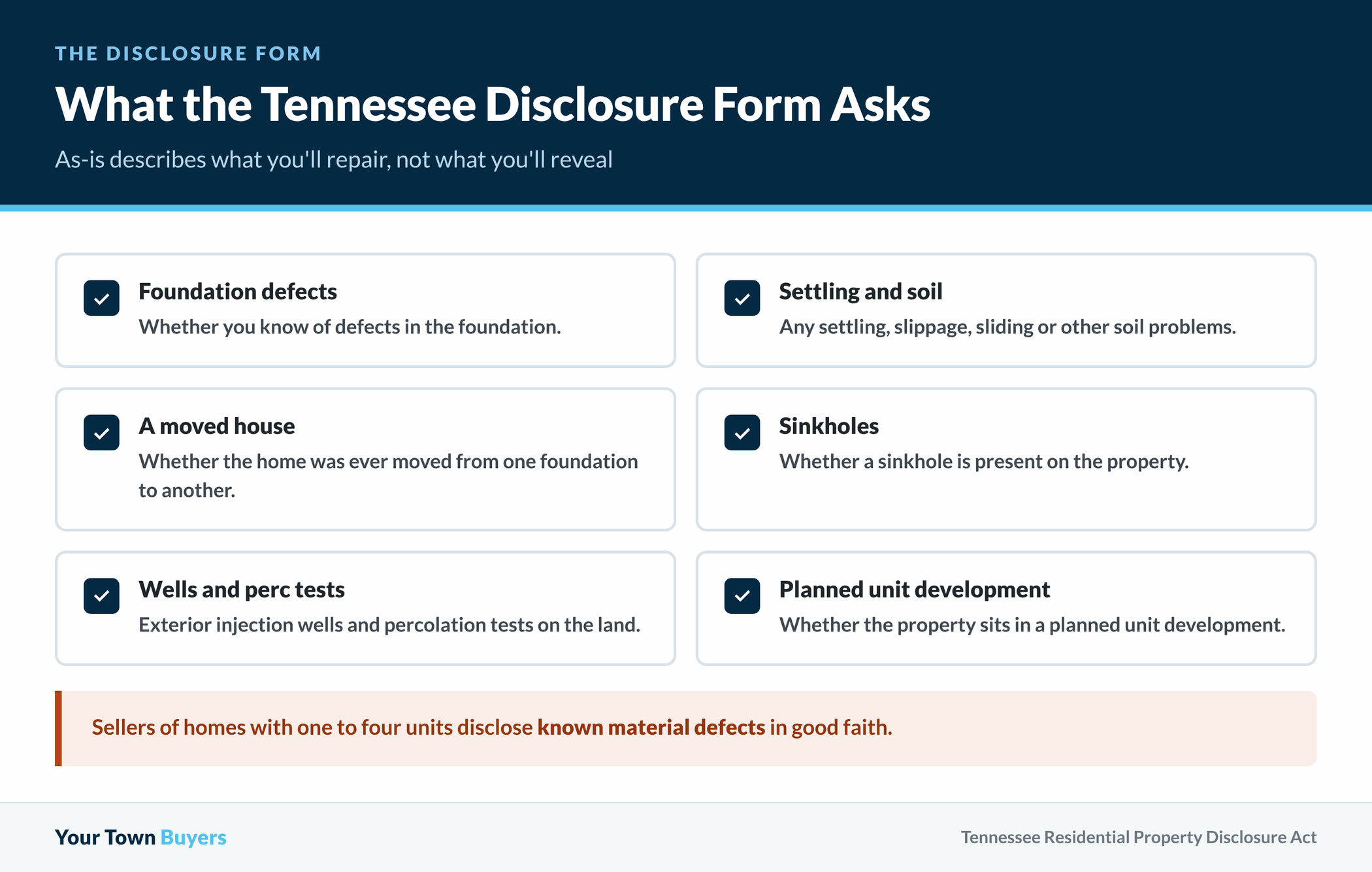
Under the Tennessee Residential Property Disclosure Act, sellers of residential property with one to four dwelling units must give the buyer a written statement of known material defects before the contract becomes binding. You can read the statute behind the Tennessee disclosure requirements before you fill anything out.
The form asks directly. One question covers known defects in the foundation, and another asks about settling, slippage or other soil problems. There’s no gray area in how those are worded.
Tennessee’s form goes further than a single yes or no box. It also asks whether the home has ever been moved from one foundation to another. Other questions cover sinkholes, exterior injection wells, percolation tests and planned unit development status. The Tennessee REALTORS form spells out that sellers must disclose all known material defects and answer in good faith to the best of their knowledge as of the disclosure date.
You are expected not to paper over what you do know.
Should you hand over the engineer’s report along with the form? My opinion: yes, every time. Sellers who withhold a report they paid for look like they’re hiding something. Tennessee buyers read that instantly. Volunteering the document about foundation problems moves the conversation to price instead of trust, which is where you want it.
Your real estate attorney can confirm how the disclosure, disclaimer, and exemption forms apply to your specific Tennessee transfer.
Should You Repair Foundation Problems Before Selling in Tennessee?
For years I told sellers to fix everything first, and I was wrong about that more often than I was right.
Repairs make sense when the scope is small and the cause is obvious. A cracked pier, a regraded yard, a bad downspout run: those are weekend-level fixes that remove an inspection objection for a few hundred dollars. Spend that money.
The math changes with structural work. Pay $22,000 for piering a Tennessee house and you almost never see that money again at closing. Buyers pay for a house without foundation problems, not for a house with an expensive receipt attached. Partial repairs are worse, since a half-finished job reads as an unresolved job to any inspector.
Timing is the other half of this. Foundation contractors in Middle Tennessee book out weeks during the spring and summer rush. The work itself can take days to settle before cosmetic repairs go back on top. If you have a job transfer, a divorce, or a probate deadline bearing down, that calendar is working against you.
Closing credits are the other route. A repair credit lets a buyer handle the work on their terms, and Tennessee buyers like picking their own contractor. Credits also keep your property on the market instead of in a construction queue.
Get two repair quotes from reputable Tennessee companies, sure. Chasing a third quote for two more weeks while your carrying costs accrue rarely changes the decision.
If repair isn’t realistic, selling the house as it stands is a legitimate path. Local buyers like Your Town Buyers buy Tennessee properties with foundation problems in their current condition. That spares you the contractor hunt entirely.
Can You Sell a Tennessee House with Foundation Problems As-is?
And yes, that route is fully open to you in Tennessee, with one condition attached: the disclosure obligation discussed earlier doesn’t disappear. As-is describes what you’ll repair, not what you’ll reveal.
Cash buyers and investors make up most of the as-is market for houses with foundation problems. The reason is simple. They aren’t asking a lender for permission.
Lenders order an appraisal, and a Tennessee appraiser who notes active structural movement can trigger a repair requirement before funding. Cash removes that gatekeeper. So does a portfolio loan from a local Tennessee bank, though those take longer to arrange.
As-is buyers still inspect, but they inspect to confirm their own repair estimate rather than to build a list of demands. The offer you accept on Monday usually looks like the offer you close on.
Expect an as-is sale in Tennessee to land below what a fully repaired, staged, MLS-listed version of the same property would bring. What you keep is certainty, speed, and the ability to skip three contractor appointments and a lender’s underwriting committee.
Carrying costs deserve a line in this calculation. Mortgage payments, Tennessee property taxes, insurance, and utilities keep running during a long listing period. Two extra months of holding a house can quietly erase the premium you were waiting for.
I’ve bought Tennessee houses where the foundation problems turned out to be cosmetic once an engineer looked, and I’ve told those sellers to list on the open market instead. That conversation costs me a sale and earns a referral. Good trade.
What Are Your Options for Selling a Tennessee Home with Foundation Problems?
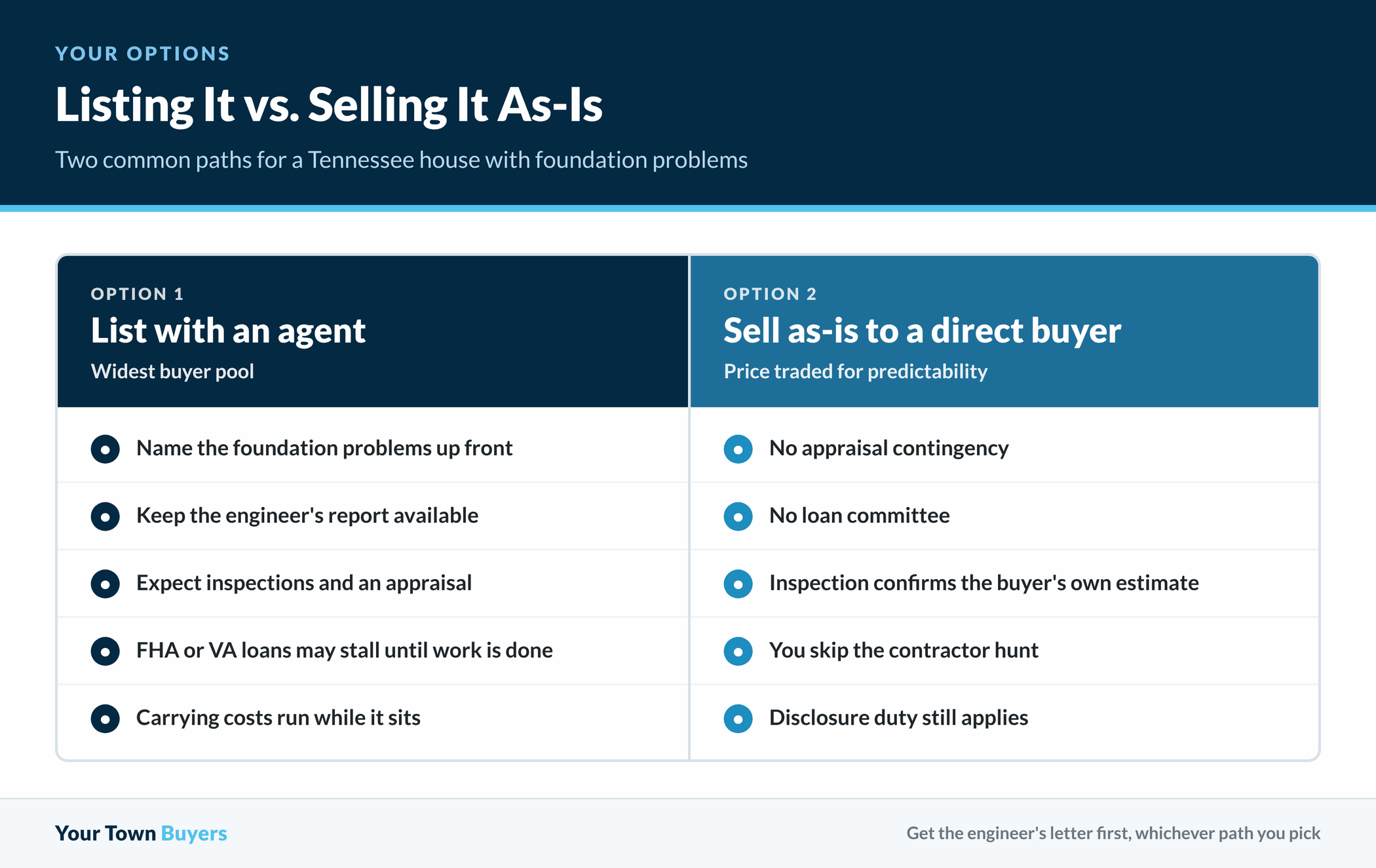
Listing with a real estate agent gives you the widest buyer pool. Pick an agent who’s handled structural issues before, not just one with a Tennessee sign in the yard. Your listing should name the foundation problems up front, with the inspection report available, so you filter out buyers who’ll bail at day 30.
Market conditions shape this choice right now.
In Knoxville, Redfin reported that prices rose 4.8 percent over the three months ending October 2026 to a $325K median, with homes selling after 49 days.
Greater Nashville ran slower. October 2026 closings hit 2,540, homes took 61 days to go under contract, and the median single-family price was $499,990 according to Greater Nashville REALTORS. Buyers have more inventory to choose from than a year ago. A house with unresolved structural questions competes against cleaner options.
Selling to a direct buyer trades price for predictability. There’s no appraisal contingency, no loan committee, and no renegotiation after a buyer’s inspector writes the word “settlement.” For heirs, landlords, and sellers already carrying two payments, that trade is usually the right one.
Owner financing comes up occasionally and works for a narrow set of Tennessee sellers. You keep a note, the buyer handles repairs, and you collect payments. It only makes sense if you own the property free and clear and have the stomach to be the lender.
Tennessee auction buyers price in the worst-case structural scenario, and you surrender control of the closing date.
Whichever path you pick, get the engineer’s letter first. It’s the single document that changes every conversation about foundation problems in a Tennessee sale, and it costs less than one month of holding the property.
How Do You Market and Close the Sale of a House with Foundation Problems?
Hiding structural issues in a listing is the most expensive mistake a Tennessee seller can make.
Put the condition in the remarks. “Known foundation movement, engineer’s report available, priced accordingly” does more work than any photo. Buyers who read that and still schedule a showing are buyers who’ll close.
Photos matter too. Sellers who shoot only the kitchen and the front elevation train buyers to expect a surprise. A Tennessee buyer who finds the crack themselves assumes you were hoping they wouldn’t.
Transferable foundation warranties are worth real money in Tennessee, and plenty of sellers forget they have one.
Negotiations go smoother when your price already reflects the condition. Holding firm at a repaired-house number and then conceding $15,000 at day 60 nets you less than pricing correctly on day one. It also burns two months.
Tennessee uses attorneys and title companies for closings, and a disclosed structural defect doesn’t cloud title. Your buyer’s lender is the only moving part that might stall.
A woman in Maryville reached out last winter while settling her father’s estate. Three decades of belongings filled the house, and a settled front porch pier had the whole corner sagging. Her two brothers wanted a clean exit without a cleanout. We closed on a Thursday, she took the photo albums and her dad’s workbench, and the rest stayed with us.
Frequently Asked Questions
Will Anyone Make an Offer on a House With Foundation Issues?
Yes. Cash buyers and investors make offers on these houses regularly, because they price the repair into the number instead of asking a lender for permission. Financed Tennessee buyers can still come to the table, especially when you hand over an engineer’s report and a contractor’s estimate up front. Clear paperwork brings more serious offers.
Will a Lender Finance a House with Foundation Problems in Tennessee?
It depends on severity and loan type. Conventional lenders tend to proceed when a licensed contractor has completed and documented the repair. Government-backed loans usually require structural work finished before closing. Cash buyers and some local Tennessee portfolio lenders have more flexibility, which is why as-is sales usually go that direction.
Do I Have to Tell Buyers About Foundation Problems I Already Fixed?
Yes. The good-faith disclosure duty described earlier covers conditions you knew about, including ones that have been repaired. Attaching the invoice and any transferable warranty turns that disclosure into a selling point rather than a red flag for Tennessee buyers.
How Long Does It Take to Sell a Tennessee House with Foundation Problems?
If you list on the open market, plan on longer than the typical timeline for your area, since a portion of financed buyers will self-select out. A direct sale to a local buyer usually closes in a couple of weeks, limited mainly by title work. Your timeline depends more on how clearly you’ve documented the condition than on the condition itself.
Can Foundation Problems Be Covered by Homeowners Insurance in Tennessee?
Usually not, if the cause is soil movement, settling, or expansive clay, since standard policies exclude earth movement. Damage traced to a sudden plumbing failure under the slab sometimes gets partial coverage. Call your carrier and ask about your specific policy language before you assume either way.
Is It Worth Getting an Engineer’s Report Before Listing?
In my experience it’s the best few hundred dollars a Tennessee seller with structural concerns can spend. It converts an open-ended fear into a defined number, and defined numbers are negotiable. Without it, every buyer who walks through assumes the worst possible repair bill.
If you’ve got a Tennessee house with foundation problems and you’re not sure which direction makes sense, we’re glad to talk it through. Sometimes the answer is listing it with an agent, sometimes it’s a quick repair, and sometimes it’s selling it to us as it sits. You can reach Your Town Buyers whenever you’re ready. No pressure, no obligation, and no hard feelings if you decide to go another way.
Foundation Problems and the Memphis Market
Our office sits in Shelby County, where plenty of older brick ranches sit on clay that moves with the seasons. Through September 2026, Zillow’s home value index put the typical Memphis home at about $151,800, down 2.8 percent from a year earlier. Homes there went pending in around 40 days.
With prices drifting and buyers taking their time, a house with foundation problems in Memphis has to be priced honestly from day one. We buy well beyond the county line, so homeowners anywhere in Tennessee can reach out about a house in any condition.
Talk With Us About Your Tennessee House With Foundation Problems
If you’d rather skip the engineer visits, repair bids and showings, we’ll look at the house as it sits and make you a cash offer with no obligation. You pick the closing date, and you’re free to list with an agent instead if that fits better. Contact Your Town Buyers and we’ll walk through your options together.
Helpful Tennessee Blog Articles
- How to Sell a House Without a Realtor in Tennessee
- Selling a Probate House in Tennessee
- How to Sell a House with Delinquent Property Taxes in Tennessee
- How to Sell a House with a Mortgage in Tennessee
- Selling a House in Foreclosure in Tennessee
- Selling a House During Divorce in Tennessee
- How Long Does an Eviction Process Take in Tennessee
- Appraisal Required Repairs in Tennessee
- How Much Do Realtors Charge to Sell a House in Tennessee
- How to File a Quitclaim Deed in Tennessee
- How Much Does It Cost to Stage a House in Tennessee
- How to Sell a Tennessee House without Repairs
- How to Sell Your House and Relocate Out of State
- Required Paperwork for Selling an Inherited House in Tennessee
- Can an HOA Foreclose on Your Home
- How Much Time It Takes to Sell a House in Tennessee
- How to Sell a House with Foundation Problems in Tennessee

Get Your Cash Offer And Sell Your House Without An Agent Today
Fill out the quick form below or call us at (901) 675-8005 to get an offer on your house TODAY!
"*" indicates required fields