

A subterranean termite colony can eat through wood for years before anyone notices a thing. That’s the uncomfortable math under a lot of Tennessee houses right now. I’ve bought property across this state for a long time, and termite damage shows up in more homes than sellers disclose, especially in older homes with crawl spaces. If you’re staring at a pest report and wondering whether your sale is dead, it isn’t. What you do in the next few weeks matters more than the bugs ever did.
How Do You Know If Your Tennessee Home Has Termite Damage?
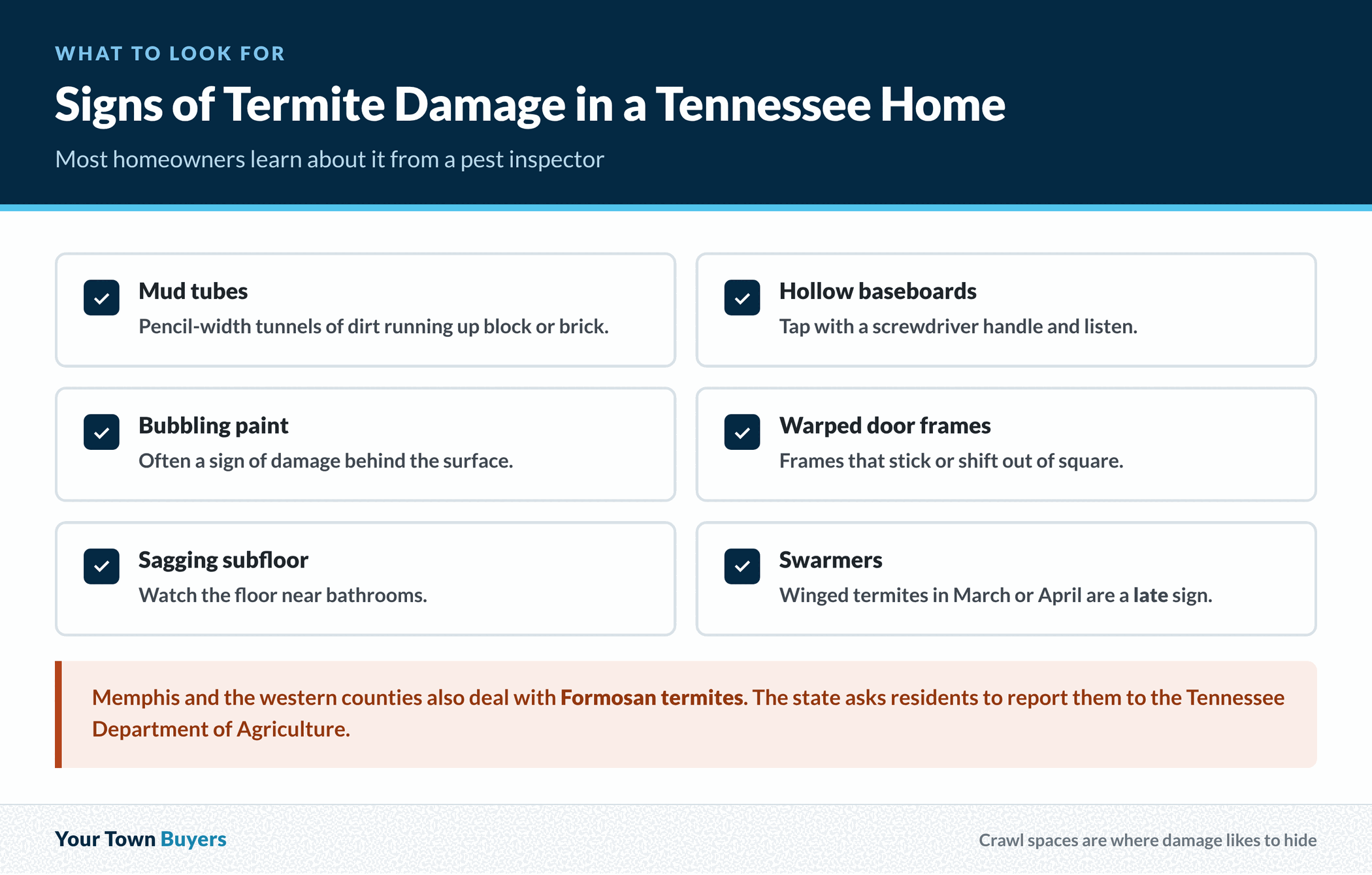
Swarmers are not the first sign. They’re the late sign. By the time you see winged termites drifting against a window on a warm spring day, the colony underneath your Tennessee house has usually been established for years. The damage is already done before you notice anything. Most homeowners here learn about the problem from a pest inspector, not from their own eyes.
Walk the perimeter of your foundation and look for mud tubes, pencil-width tunnels of dirt running up block or brick. Inside, tap baseboards with a screwdriver handle, since hollow sounds mean wood that’s been eaten from the inside out. Bubbling paint, warped door frames, sagging subfloor near a bathroom: those all point the same direction.
Crawl spaces are where Tennessee termites like to hide. Summer humidity sits under these houses for months, and subterranean colonies love damp sill plates. Memphis has its own wrinkle: Formosan termites, a more aggressive species, have turned up there before, although UT Extension says they aren’t established in the area. If an inspector suspects one, the local extension office can confirm the species.
Last year I bought a house from a widow. Nobody had crawled under it since her husband died, and the termite damage along the rear sill plate had been working away the whole time.
When did anyone last crawl under your house? Not glance at it from the vent, but crawl it with a flashlight. In my experience, the gap between “I think we’re fine” and a documented inspection is where Tennessee sellers lose the most money.
How Much Damage Can Termites Really Cause to a Tennessee Home?
“It’s just bugs, how bad can the framing be?” I hear versions of that in nearly every kitchen. Pretty bad, sometimes. Termites don’t collapse a house overnight, but they hollow load-bearing members quietly until a floor joist flexes when you walk across it.
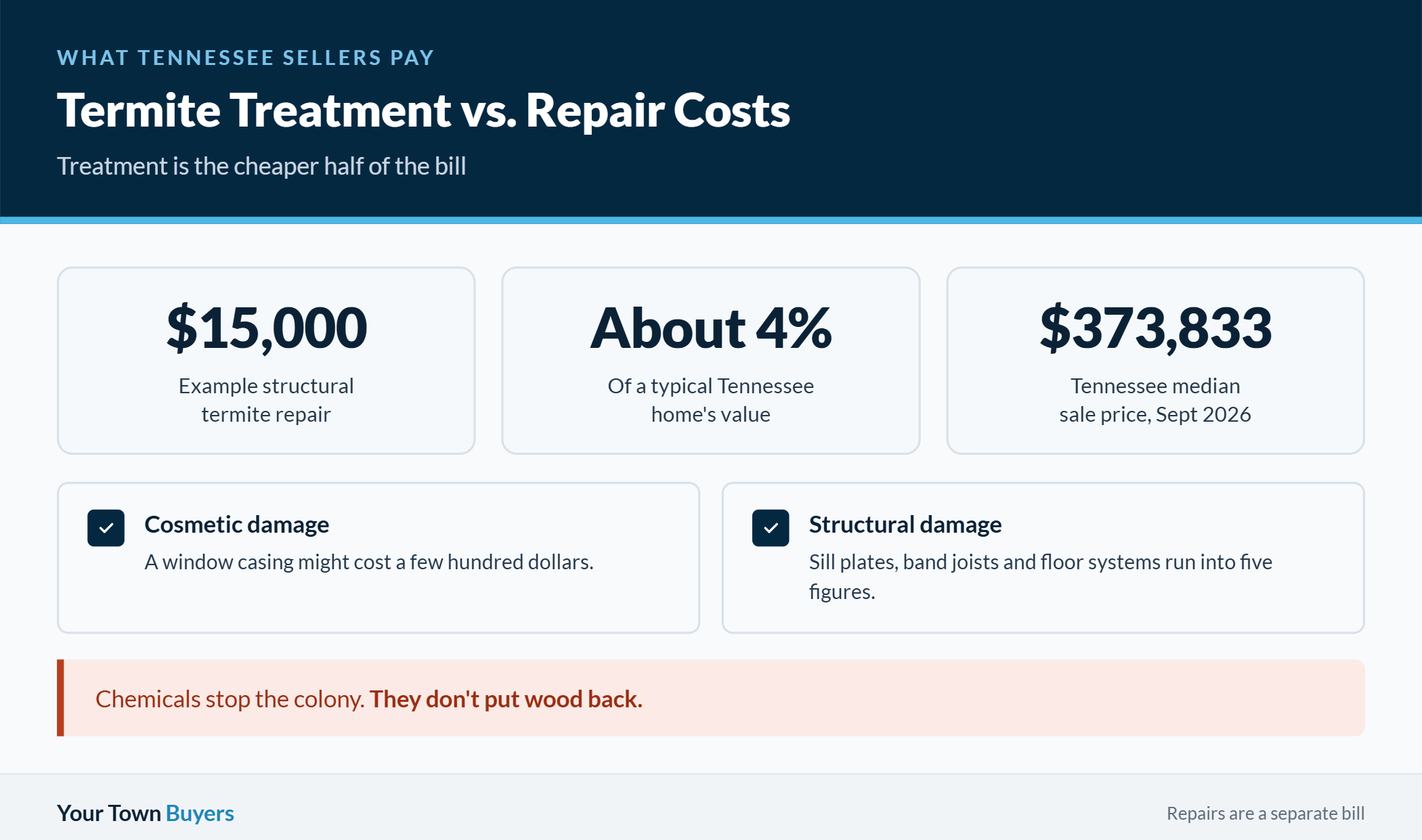
Repair bills cover an enormous range. Cosmetic termite damage to a window casing might cost a few hundred dollars. Structural termite damage to sill plates, band joists, and floor systems can run into five figures once a contractor starts jacking up a corner of your Tennessee home.
Treatment itself is the cheaper half. A chartered company quotes termite treatment after an inspection, and the price moves with the size of the house, the crawl space and the method it uses. Fixing what the colony already ate is a separate bill, and that’s the one that scares buyers.
Scale only means something next to your equity. Redfin put Tennessee’s median sale price at $373,833 in September 2026, so a $15,000 structural repair is about four percent of a typical home’s value. That’s survivable on paper. It rarely feels survivable when you’re also paying a mortgage and waiting on three contractor bids that never arrive.
Older houses carry more risk. Plenty of older houses across Memphis and its Shelby County suburbs have wood in direct contact with the soil. Many of them went up before termite pretreatment was routine. Wood touching dirt explains most of the severe termite damage I’ve walked through in Tennessee.
One pattern I keep noticing: sellers underestimate the damage and overestimate the treatment. They’ll pay for chemicals and assume the house is now fixed. Chemicals stop the colony. They don’t put wood back.
What Do Tennessee Buyers Need to Know About Termite Inspections?
You can’t hide this, and trying to is the single most expensive mistake available to you. Tennessee’s Residential Property Disclosure Act has the seller fill out a disclosure statement, and termite damage belongs on it, since the standard form asks about damage from wood destroying organisms. You deliver it to the buyer before a sales contract is accepted.
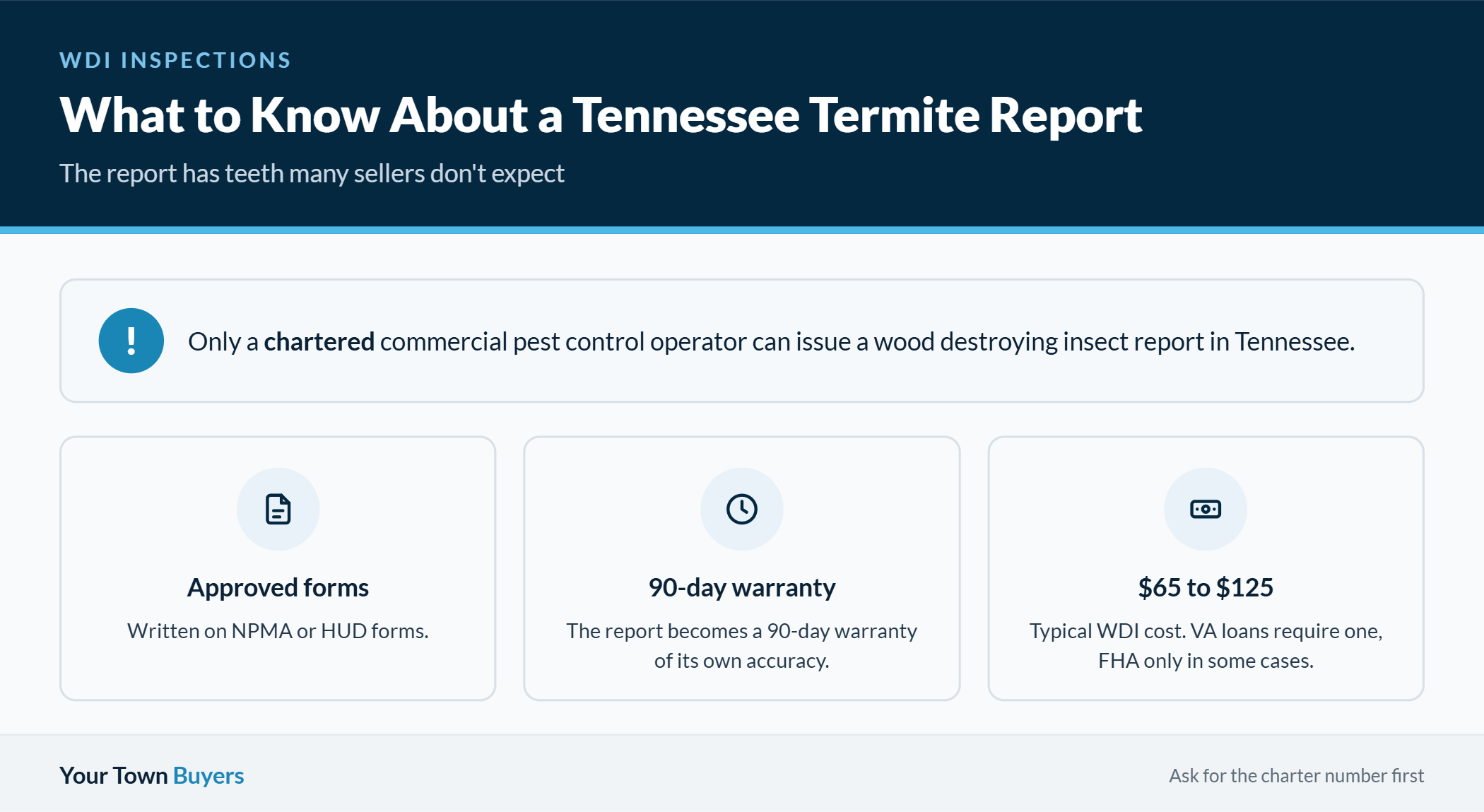
The inspection report has teeth you may not know about. Under Tennessee law, a wood destroying insect infestation inspection report can only come from a chartered pest control operator. It states whether visible insects and visible damage were found after an on-site inspection. The report has to show a graph of the property, any areas of damage or active infestation, and the operator’s charter number. It also works as a 90-day warranty of its own accuracy.
Who pays is negotiable, so make sure the sales contract spells it out. Tennessee doesn’t require a termite inspection on every home sale. VA loans do call for a WDI report here, since the whole state sits in a zone rated moderate to heavy for termites. FHA asks for one when the appraiser sees signs of infestation, when it’s customary in the area, or when the lender wants it. Plenty of conventional lenders and buyers ask for one too.
You can verify any operator before you hire them. State law only lets chartered firms issue these reports, and they go on forms prescribed by the National Pest Management Association and HUD. The Tennessee Department of Agriculture lists chartered companies on its website.
An unchartered inspector’s clean report is worth nothing at a Tennessee closing. Ask for the charter number first.
Should You Repair Termite Damage or Sell the House As-is in Tennessee?
Every seller hits the same fork in the road. Repair, or sell with the termite damage disclosed and priced in? Full structural repair before listing is the wrong call for a lot of the Tennessee sellers who attempt it.
Repairs make sense when the damage is contained, your contractor can start within two weeks, and you have cash that isn’t earmarked for something else. Fixing a few rim joists and replacing a section of subfloor can return more than it costs when retail buyers tour the house.
Contractors tend to find more once the drywall comes off. Open one wall, find termite damage in the next bay, and your two-week project turns into six. Statewide, homes were taking a median 68 days to sell in September 2026, according to Redfin. A repair delay stacks on top of a selling timeline that had already stretched past last year’s pace.
The law here lets you choose a path. Sellers here may provide either a disclosure statement or a disclaimer statement associated with an as-is sale, though the disclaimer route is only available when the buyer has waived the required disclosure. As-is doesn’t mean silent, and I’d still put known termite damage in writing.
Financing is where a lot of these sales quietly die. When an FHA or VA loan calls for the report, active infestation usually has to be treated before closing. That narrows your pool to cash buyers and conventional buyers who don’t mind condition issues. Local buyers like Your Town Buyers handle exactly that category of Tennessee property without asking you to touch a thing.
What Should You Do Before Selling a House with Termite Damage in Tennessee?
For a long time I told sellers to get the treatment done first and worry about paperwork later. It was backwards advice, and I’ve stopped giving it.
Paperwork is your leverage. Get a written WDI report from a chartered Tennessee operator, keep every treatment receipt, and hang onto the graph of the property that your contract should include. State rules make every termite control contract list an inspection date and a graph of the property it covers. A future buyer can read that graph and see where the activity was.
Next, get two or three repair estimates in writing before you price anything, because a buyer who sees termite damage with no number attached imagines the worst number. A buyer who sees three contractor bids negotiates against the middle one.
Then fill out your disclosure honestly, including infestations you treated years ago. The standard form asks about damage from wood destroying organisms, and old damage counts along with current activity. You’ll find the disclosure statute in Title 66 of the Tennessee Code, and a real estate attorney can walk you through what belongs on the form.
Should you re-treat before listing? If the colony is active, yes. A transferable termite bond is a genuine selling asset in Tennessee. State rules have the company inspect a property under contract every year. If termites show up somewhere new, the company has to treat that spot and draw a fresh graph.
One more thing sellers skip: photograph everything before repairs begin. I’ve watched buyers’ agents claim damage was worse than disclosed, and the seller had nothing but memory to argue with.
What Are Your Options for Selling a Termite-damaged House in Tennessee?
List it, get a good offer, fix the small stuff, close in forty-five days. It looks clean on a whiteboard. Then the buyer’s inspector spends an hour in the crawl space, the lender sees “active infestation” on the WDI form, and your forty-five days becomes a renegotiation you didn’t budget for.
Three realistic paths exist for Tennessee sellers with termite damage.
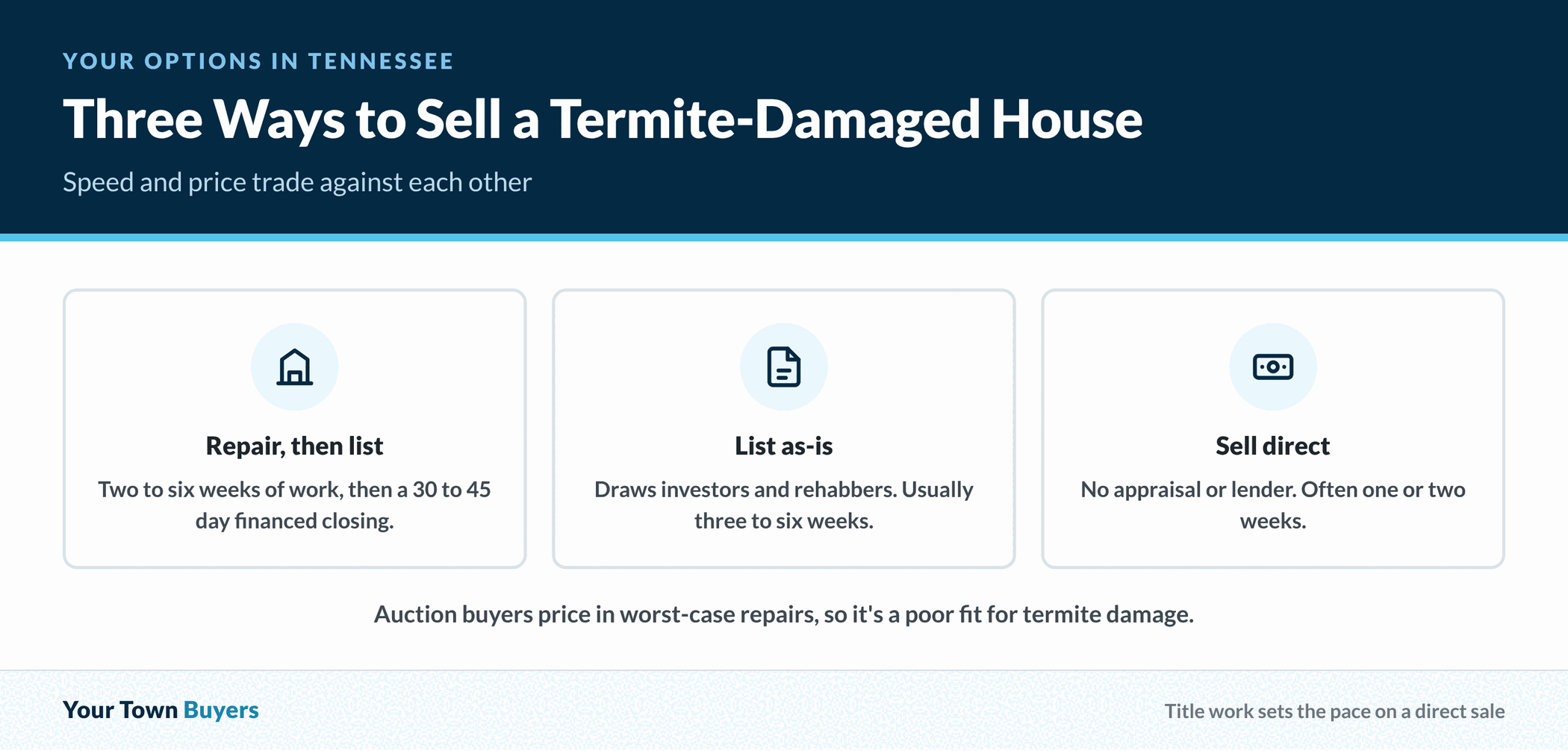
Traditional listings with repairs completed work best where buyers still compete. Around Memphis, buyers have room to compare right now. A seller carrying repair costs through weeks of showings pays for every day the house sits.
Listing as-is with full disclosure pulls in investors and rehab buyers. You’ll see offers below retail, but you skip contractors altogether, and your Tennessee closing doesn’t hinge on a clearance letter.
Selling directly to a local buyer removes the financing contingency, so there’s no appraisal and no lender reading the termite damage section of a report and pulling back. Your Town Buyers takes that approach with Tennessee homeowners who’d rather trade some price for certainty.
Auction is a fourth option people mention. I’d skip it for a house with termite damage. Auction buyers price in worst-case repair scenarios, and you lose the ability to explain what’s already been treated.
Who Buys Houses with Termite Damage in Tennessee?
Price your Tennessee house as if the colony never touched it, and it can sit for ninety days. Two price drops later, you end up below what a direct offer would have paid in week one. I’ve seen that sequence more times than I can count.
Investors and rehabbers are the biggest group I run into. They price from repair cost, not from fear, and termite damage is a line item they’ve handled fifty times. Second: owner-occupants paying cash, often buying in neighborhoods they already know, like the older parts of Memphis or the established suburbs around it.
Conventional buyers with contractor relationships form a third group. They’re rarer, they negotiate hard, and they usually want the Tennessee seller to credit repairs at closing rather than fix anything.
Sellers use local market knowledge to separate fair offers from insulting ones. A buyer who doesn’t know your part of Shelby County can underprice your house by a wide margin. A seller looking for cash home buyers in Germantown faces different comps than one in Millington. This state is not one market. It’s a dozen.
Reputation is worth checking. Ask any Tennessee buyer how many houses they’ve closed in your county and whether they’re funding with their own money. Also ask what happens if the termite damage turns out to be worse than the photos showed. Answers should come fast and without hedging.
How Fast Can You Sell a House with Termite Damage in Tennessee?
“Can I be out before the holidays?” I hear that question more than any other, usually in October.
The timeline depends on which path you pick. A traditional Tennessee listing with repairs means two to six weeks of contractor work, then marketing time, then a thirty to forty-five day financed closing. Add the state’s current pace and you’re really looking at three to four months from the day you decide.
A direct sale compresses that to one or two weeks in most Tennessee counties. Title work is the gating factor, not the termite damage, so if the title’s clean, with no probate and no liens, closing can happen as fast as the title company can schedule it.
Listing as-is to investor buyers lands in the middle, usually three to six weeks. Condition issues like termite damage pull the final price further below list, so speed and price trade against each other every time.
A landlord in Bartlett called me about a duplex he’d owned for a decade. His contractor’s estimate for the kitchen side of the building, where termite damage had worked up behind the cabinets, came back higher than what the whole kitchen contributed to the property’s value. He just wanted the building gone.
The sale closed as-is on a Thursday, and he never swung a hammer. Right call, given his numbers.
Frequently Asked Questions About Termite Damage in Tennessee
Are Drywood Termites Hard to Eliminate Once They’re in a House?
They’re stubborn, mainly because they live entirely inside the wood rather than in soil, so soil treatments don’t touch them. Spot treatments like foam injections or borate sprays work when the infestation is confined to a few members, but widespread activity sometimes calls for whole-structure fumigation. Drywood species are far less common in Tennessee than subterranean termites, though a licensed inspector will identify which one you’re facing before anyone recommends a treatment plan.
What Does a Termite Inspection Run in Tennessee?
A standard inspection is one of the cheaper professional services you’ll buy during a sale, and pricing tends to sit in a fairly narrow range. Plenty of chartered Tennessee companies will inspect for free when you’re thinking about treatment with them, but the documented report lenders want is almost always a paid service. Call two or three operators in your county and compare, since pricing shifts with square footage and how easy the crawl space is to reach.
How Much Does Termite Damage Reduce What a Tennessee Home Is Worth?
There’s no fixed percentage, and anyone quoting you one is guessing. Buyers deduct the repair estimate plus a cushion for what might be hiding behind the walls, so untreated active infestation costs you more than documented, treated damage with receipts attached. The sellers who lose least are the ones who hand buyers a paper trail instead of leaving them to imagine the worst.
Do I Have to Disclose Old Termite Damage That’s Already Been Repaired?
Yes. Tennessee’s disclosure form covers known damage from the past, not just whatever is crawling around today. Disclose the old damage, attach the treatment records and the repair invoices, and you turn a liability into evidence that you took care of the house. Buyers respond far better to that than to a blank line on a form.
Will a Lender Approve a Loan on a Tennessee House with Termite Damage?
It depends on the loan type and the severity. When a VA or FHA loan calls for a wood destroying insect report, active infestation generally has to be treated and documented before closing. Conventional lenders have more room to bend, but an appraiser who flags structural concerns can still derail the file. Cash buyers sidestep the issue completely, which is why so many termite-damaged Tennessee homes end up trading that way.
Termite Damage and the Memphis Market
Zillow put the typical home value in the city at $151,794 through September 2026, down 2.8 percent from a year earlier. Homes in Memphis were taking about 40 days to go pending. Buyers there have time to compare, so a house with termite damage on an open pest report often sits longer.
A clear plan matters more here than in a hot market. You can treat the colony and price the repairs into your listing. Or you can sell the house as it stands to a local buyer who already expects the damage.
Get a Cash Offer on Your Termite-Damaged House
If a pest report has your sale stuck, you can reach out to Your Town Buyers and tell us about the house. We buy Tennessee homes with termite damage as they are, so you don’t need to treat, repair or clean anything first. You’ll get our number and an explanation of how we got there. There’s no obligation, and you can take your time deciding. The form below is the quickest way to start.
Helpful Tennessee Blog Articles
- How to Sell a House Without a Realtor in Tennessee
- Selling a Probate House in Tennessee
- How to Sell a House with Delinquent Property Taxes in Tennessee
- How to Sell a House with a Mortgage in Tennessee
- Selling a House in Foreclosure in Tennessee
- Selling a House During Divorce in Tennessee
- How Long Does an Eviction Process Take in Tennessee
- Appraisal Required Repairs in Tennessee
- How Much Do Realtors Charge to Sell a House in Tennessee
- How to File a Quitclaim Deed in Tennessee
- How Much Does It Cost to Stage a House in Tennessee
- How to Sell a Tennessee House without Repairs
- How to Sell Your House and Relocate Out of State
- Required Paperwork for Selling an Inherited House in Tennessee
- Can an HOA Foreclose on Your Home

Get Your Cash Offer And Sell Your House Without An Agent Today
Fill out the quick form below or call us at (901) 675-8005 to get an offer on your house TODAY!
"*" indicates required fields