
Seven percent of home purchase contracts signed in the three months before the September 2026 reading never made it to the closing table. That’s from the National Association of Realtors’ REALTORS® Confidence Index, and most of those collapses trace back to financing or inspections. A small slice is something uglier: a seller refuses to close after signing, and the buyer is left holding a contract nobody will honor. I’ve bought houses for years, and I’ve sat on both sides of that table. What follows is what I wish every buyer knew before the signing date came and went.
What Happens If a Seller Refuses to Close on a Real Estate Deal?
“Can they really just do that?” That’s the first thing buyers ask me, usually in a voice somewhere between panic and fury.
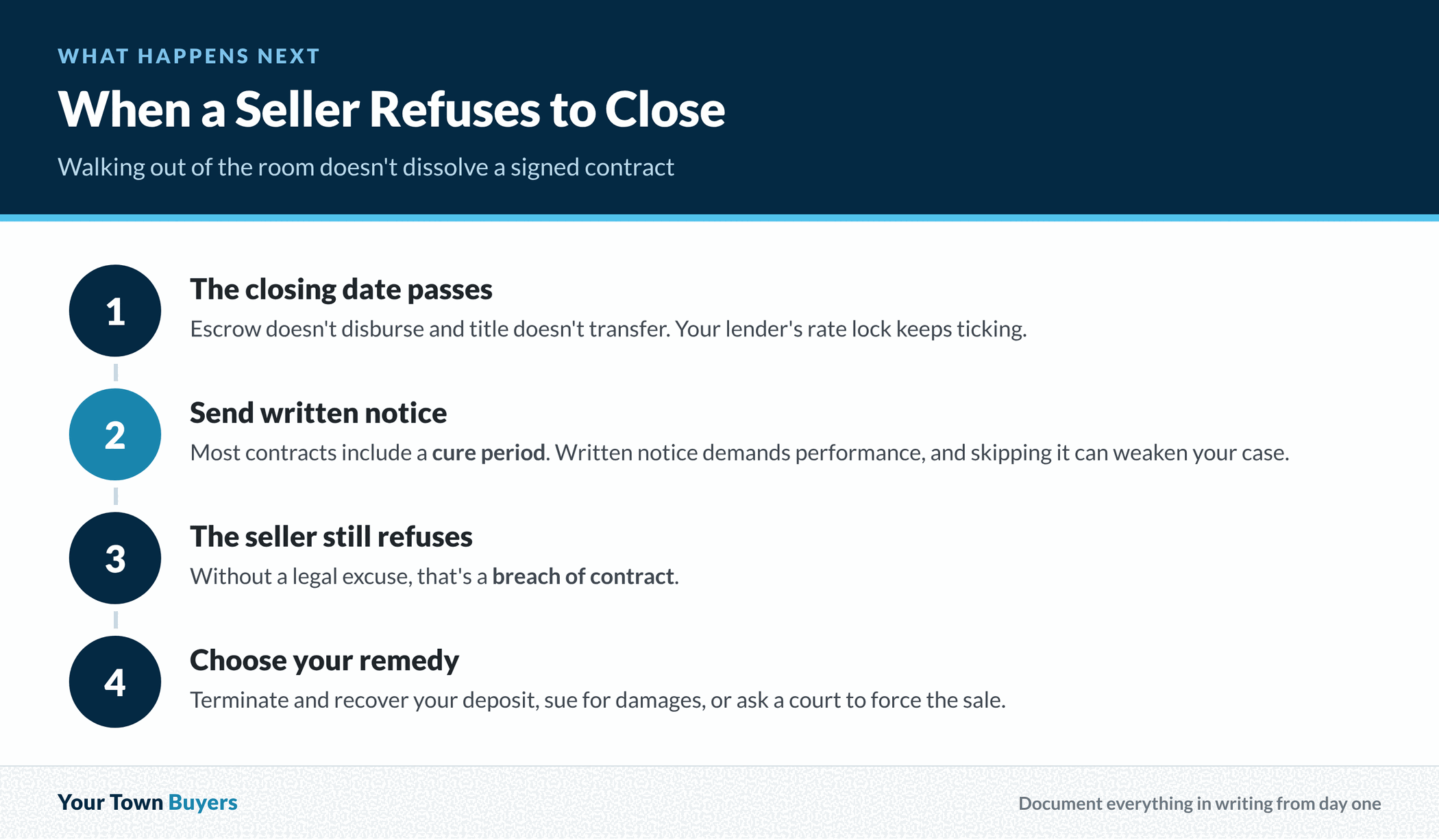
Short answer: they can walk out of the room, but walking out doesn’t dissolve the contract. A signed purchase agreement is a binding promise to convey property on agreed terms. When a seller refuses to close without a legal excuse, that’s a breach of contract, and breach has consequences the seller rarely thinks through.
What happens next depends almost entirely on what your paperwork says. Escrow doesn’t disburse. Title doesn’t transfer. The lender’s rate lock keeps ticking toward expiration while your moving truck sits reserved. Most contracts include a cure period, a short window where the non-breaching party sends written notice and demands performance. Miss that notice step and you can weaken your own case later.
Timing pressure is real here. Contracts in the September 2026 index typically closed 30 days after signing, so a seller who stalls two weeks has already blown half the normal runway.
Earnest money should come back if you terminate because the seller refuses to close, though escrow usually won’t release it until both parties sign off or a court instructs them. Sellers who are stalling sometimes refuse to sign the release too, which is its own flavor of leverage. Document everything in writing from day one.
A couple of years ago I was buying a small ranch house from an out-of-state heir. She’d gotten a contractor estimate to redo the kitchen that came in higher than the kitchen itself was worth. She panicked and told us she wasn’t signing anything. We talked it through on a Saturday phone call, restructured the offer as-is, and closed without her ever touching a hammer.
Can a Seller Legally Refuse to Close on a House?
Contracts cut both ways, and plenty of purchase agreements quietly limit what a buyer can demand if the seller bails. Some commercial and investor-drafted agreements contain waiver language where the buyer gives up the right to force the sale at all. Courts generally won’t rewrite terms that sophisticated parties negotiated themselves. So the honest answer to whether a seller refuses to close lawfully starts with reading your own contract before you read anything on the internet.
Legitimate reasons exist. A seller can back out when a contingency in the agreement gives them that right: a kick-out clause, a failed replacement-home contingency, an attorney review period that hasn’t expired yet. Title problems count too. If the seller discovers they can’t deliver clear, marketable title because of an undisclosed lien or a sibling who owns half the property, they’re not refusing so much as unable.
Prices nationally rose 1.3 percent year over year to a median of $417,500 in September 2026, per NAR’s existing-home sales report. When a seller watches comparable homes tick up during a 45-day escrow, chasing a higher market price starts to sound tempting.
State law shapes the rest. Remedies, notice requirements, and how aggressively courts enforce real estate contracts vary from one state to the next, and a few states treat certain remedies differently depending on which party breached. Your state bar association’s lawyer referral service or a local real estate attorney can tell you how your jurisdiction handles it; I won’t pretend one rule covers all fifty.
What Are Your Legal Options When a Seller Refuses to Close?
A landlord I know went under contract on a duplex. The day before closing, the seller announced his adult son had decided to move in instead, and no contingency covered that. The buyer had already given notice to his own tenants.
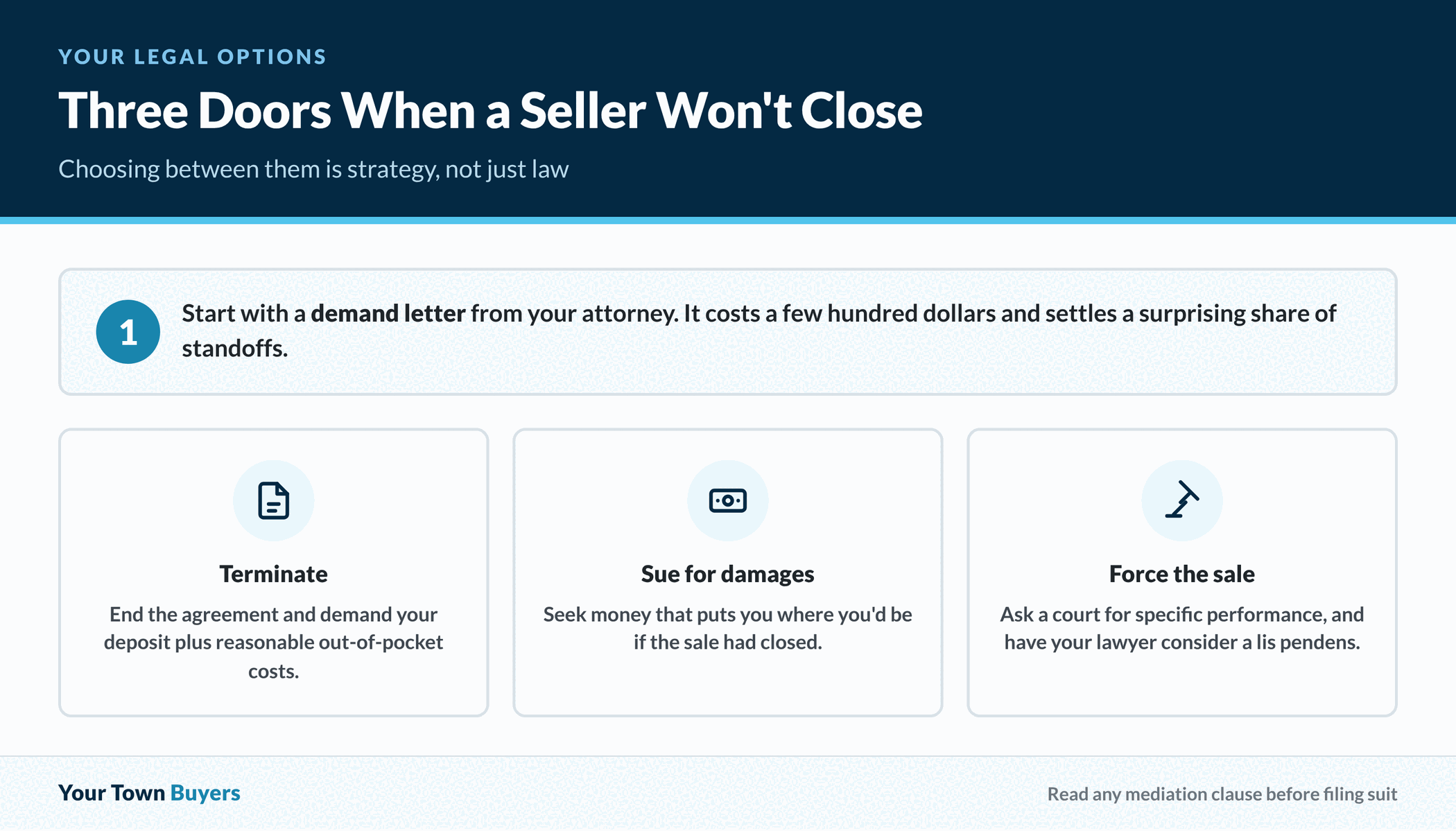
Three doors are generally open when a seller refuses to close, and choosing between them is strategy, not just law. You can terminate the agreement and demand your deposit plus reasonable out-of-pocket costs, sue for monetary damages, or ask a court to force the sale through.
Before any of that, send formal written notice through your attorney. A demand letter costs a few hundred dollars and resolves a surprising share of these standoffs, because sellers who are bluffing fold once they see a letterhead.
Most buyers skip this step at their peril. If you intend to pursue the property itself, your lawyer may record a notice of pendency of action, commonly called a lis pendens, in the county land records. That filing puts the world on notice that a lawsuit involving title to the property is pending. Skip it and the seller can convey to someone else who buys without knowledge of your claim.
Many purchase agreements also require mediation before anyone files suit. Read that clause carefully, since filing in violation of it can cost you attorney fees even if you eventually win.
What Does Specific Performance Mean When a Seller Refuses to Close?
Specific performance is the most oversold remedy in residential real estate, and buyers should go in knowing courts don’t hand it out freely.
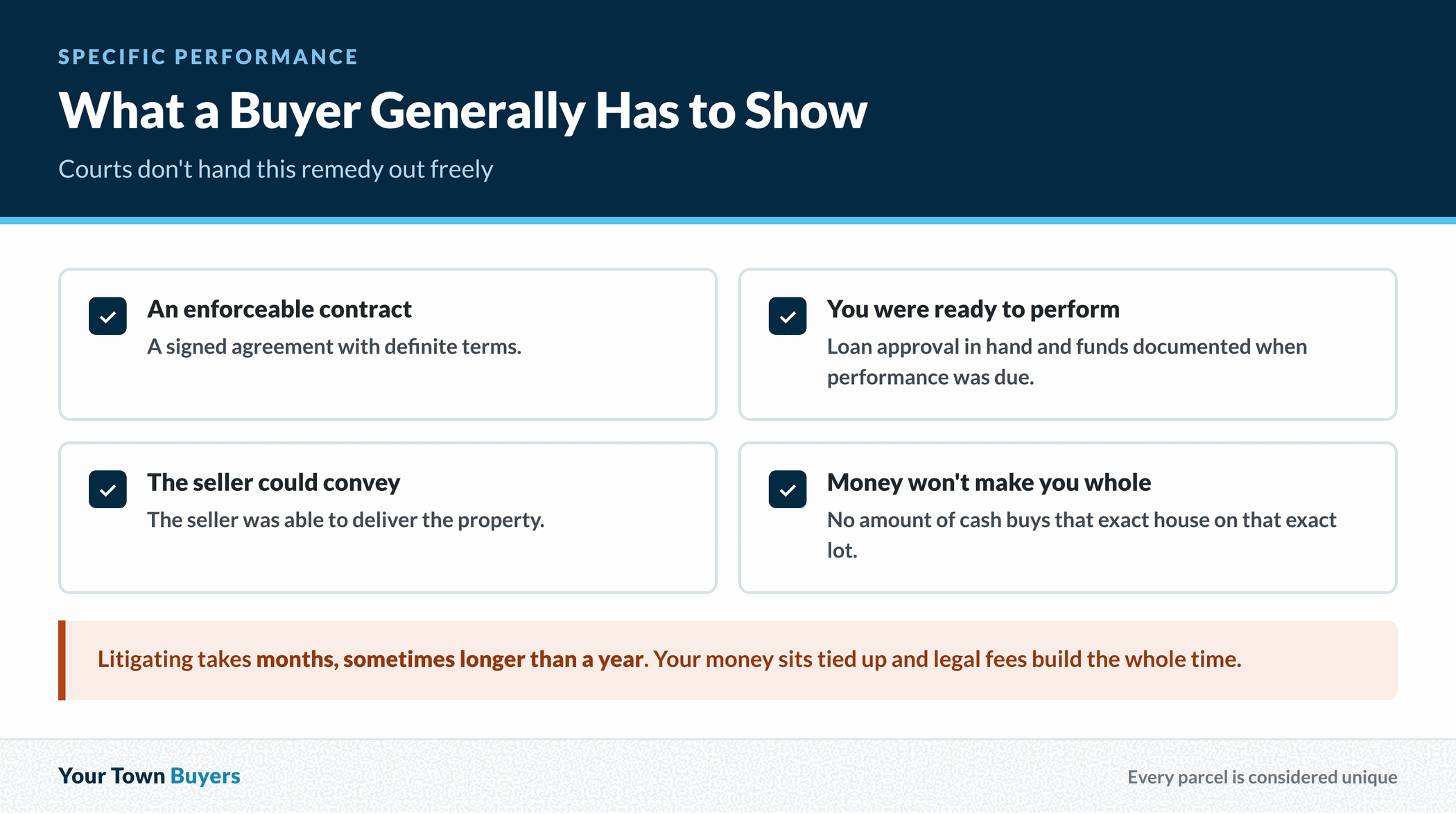
A court orders the breaching party to actually do what they promised rather than just pay for breaking the promise. Legal publishers describe it as asking a judge to compel the seller to complete the transaction on the original terms. Real property gets this special treatment because every parcel is considered unique; no amount of cash buys you that exact house on that exact lot.
To win, a buyer generally has to show four things. The contract is enforceable, with definite terms. The buyer performed or stood ready to perform, and the seller was able to convey. Money alone also wouldn’t make the buyer whole. Being “ready, willing and able” isn’t a feeling. It means loan approval in hand and funds available, documented, at the time performance was due.
Courts can award damages alongside the order too. One California firm notes that a decree can include costs like paying to extend a rate lock while litigation drags on.
Litigating after a seller refuses to close takes months, sometimes longer than a year. Your money sits tied up, your housing plans freeze, and legal fees accumulate the entire time.
That tradeoff is why I tell people to price the fight honestly against simply walking and buying something else. Inventory reached 1.60 million units with a 4.8-month supply in that same September 2026 report, so there are other houses out there. Suing for the house makes sense when the property genuinely has no substitute: an adjoining lot, a family homestead, a commercial parcel with a specific zoning fit.
Can You Sue a Seller Who Refuses to Close Escrow?
Which brings up the question buyers ask next, usually after the adrenaline fades: is a lawsuit worth it at all?
You can sue. Breach of contract claims over failed real estate transactions are filed in trial court every week in this country.
Filing starts with a complaint laying out the agreement, the seller’s refusal, and the remedy you want. Attorneys often plead breach of contract and specific performance together, asking the court for one or the other. Discovery follows: emails, texts, escrow records, the listing agent’s file. Depositions come after that.
Statutes of limitation apply, and the clock typically starts the day the seller repudiates or when the seller refuses to close on the scheduled date. Those periods differ across states, sometimes by years. Your state court system’s self-help pages or a local attorney can confirm yours before you lose the right by waiting.
One practical warning about recording that notice of title litigation I mentioned: do it carelessly and you expose yourself. States impose penalties for groundless filings, including mandatory fee awards against the person who recorded it. Let your lawyer make that call after reviewing whether the contract truly supports your claim.
A seller facing both a title cloud and a fee award tends to rediscover their willingness to sign.
What Compensation Can Buyers Get When a Seller Refuses to Close?
“Won’t I just get my deposit back and nothing else?” Not necessarily, and that assumption costs buyers money every year.
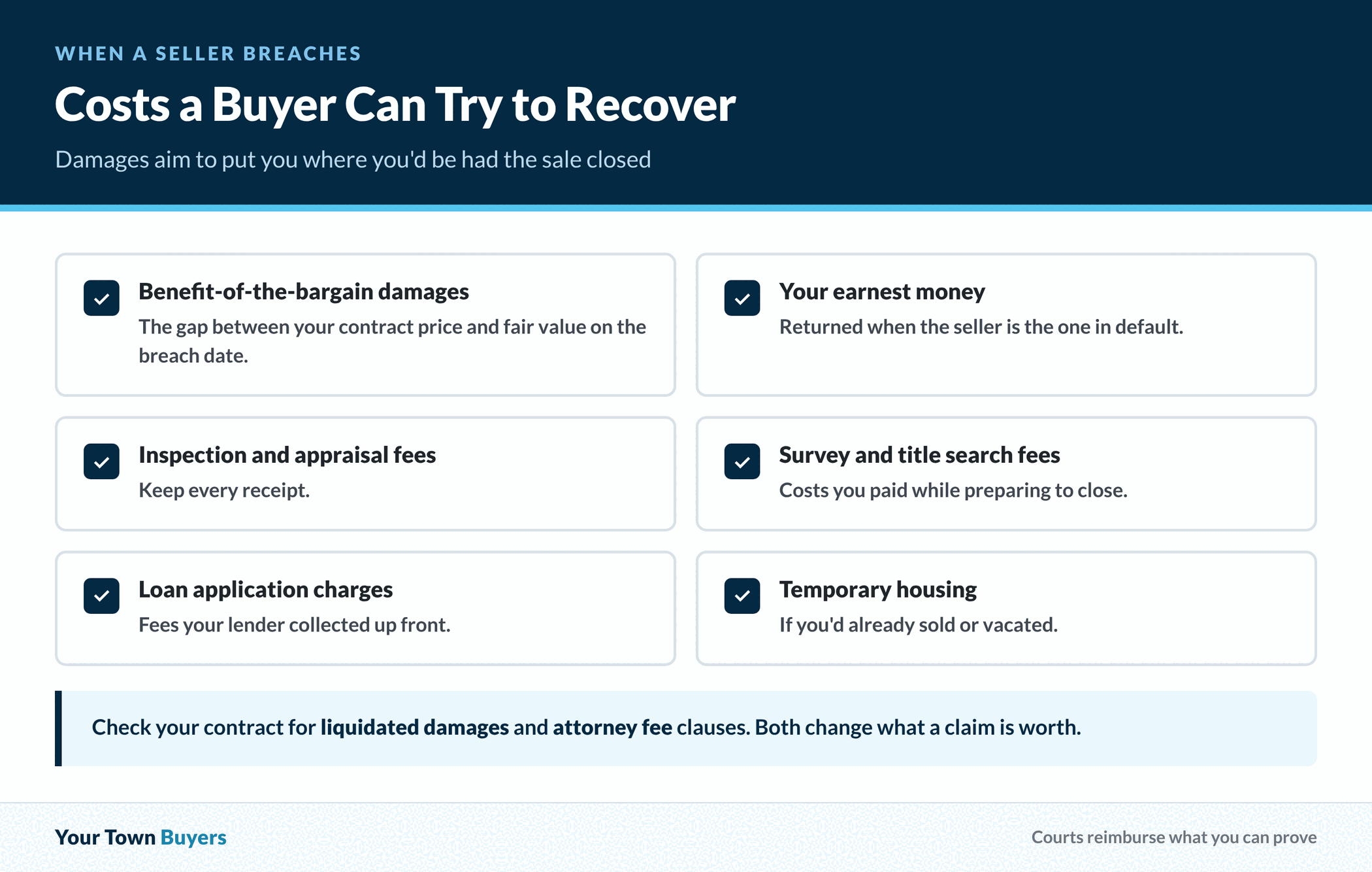
Monetary damages in these cases are built to put you where you’d have been had the transaction closed. The headline component is usually benefit-of-the-bargain damages, which means the gap between your contract price and the property’s fair value on the breach date. If you locked in below market and the seller walked, that spread belongs to you.
Inspection fees, appraisal costs, survey work, loan application charges, title search fees, and temporary housing if you’d already sold or vacated. Keep the receipts; courts reimburse what you can prove and nothing you can’t.
Some contracts contain liquidated damages clauses capping what a buyer may recover. Others provide for the prevailing party to recover attorney fees, which changes the economics of the whole dispute. Check both clauses before you decide anything.
Proving the fair-value number usually takes an appraisal as of the breach date. Pending home sales fell 7.3 percent in September 2026 according to NAR, so a softening market can shrink that spread even when the seller clearly breached. Damages math follows the market, not your frustration.
An attorney can tell you what your claim is realistically worth. Get that number before you spend six months chasing a seller who refuses to close.
Do You Need a Real Estate Lawyer If a Seller Refuses to Close?
Your agent handled the offer, the counteroffer, the inspection negotiation, and every piece of paper so far, so calling them first feels natural. Then everything falls apart and you hit the wall, because agents aren’t licensed to interpret contract remedies, draft demand letters, or record anything in the land records. Some states require attorney involvement in closings anyway; most don’t, which is exactly why buyers find themselves unrepresented at the worst possible moment.
Get a consultation. Many real estate attorneys offer an initial meeting at low or no cost, and an hour of review tells you whether your contract gives you leverage or quietly took it away.
Bring the full file: the executed agreement, every addendum, your loan commitment, proof of funds, the escrow instructions, and the complete message thread with the seller or their agent.
I’ll offer an opinion that cuts against typical advice: not every buyer should lawyer up. So if your earnest money is modest and the seller refuses to close over something you could never fix, a clean termination and a refund may beat a fight.
Last fall I bought from a homeowner who was three months behind on her mortgage with an auction date already on the calendar. Her first buyer had stalled, then vanished. She’d been sleeping in the front room because the upstairs heat quit, and the garage held nothing but a dead chest freezer and boxes of her late husband’s fishing gear. We closed before the sale date. If you’re a seller feeling cornered like that, talking to a direct buyer such as Your Town Buyers early beats waiting until a contract blows up.
Frequently Asked Questions
What Happens If the Seller Doesn’t Close on Schedule?
Missing the closing date doesn’t automatically kill the contract, since many agreements build in a short grace period or let either side extend by written agreement. If the delay stretches on without explanation, your attorney sends formal notice demanding performance by a specific date. Should the seller still refuse, you’re into breach territory and the remedies described above open up: terminate and recover your deposit, sue for damages, or ask a court to compel the sale.
Can a Seller Refuse to Let You Do a Final Walk-through?
Nearly every standard purchase agreement gives the buyer a right to inspect the property shortly before closing, so a flat refusal usually violates the contract itself. A seller blocking access is often hiding damage, unfinished repairs, or belongings that were supposed to be gone. Don’t close until you’ve seen it. Tell your agent and your attorney immediately, push the closing date if you must, and put the refusal in writing so there’s a record if the dispute escalates.
Will I Get My Earnest Money Back If the Seller Backs Out?
In almost every case, yes. When the seller is the one in default, your deposit returns to you. Escrow typically won’t release funds, though, until both parties sign a cancellation or a court tells the escrow agent what to do. If the seller stonewalls the release form, that itself is a claim your attorney can raise. Hold onto your receipts for inspections and appraisals too, since those costs are often recoverable separately from the deposit.
How Long Does a Lawsuit Against a Seller Usually Take?
Plan on months at minimum and be unsurprised if it runs past a year, especially where discovery and depositions are involved. Court congestion, the complexity of your contract, and whether the seller fights or settles all move that timeline. Many of these disputes resolve before trial once both sides see the costs stacking up, which is one reason a well-drafted demand letter is worth sending early.
Should I Keep Looking at Other Houses While This Plays Out?
That depends on which remedy you’re chasing. If you’re asking a court to force the sale, you generally have to remain ready and able to buy that specific property, and tying up your financing elsewhere can undercut your claim. If you’ve decided to pursue damages instead, keep shopping; courts expect buyers to take reasonable steps to limit their losses rather than sit idle.
Can a Seller Back Out Because They Got a Better Offer?
No. A signed purchase agreement locks in the price, and watching comparable homes appreciate during escrow gives nobody a legal exit. Sellers in this position sometimes try to manufacture a reason, claiming a repair request was unreasonable or a deadline was missed. Save your correspondence, because that paper trail is usually what settles the argument.
What If the Seller Is in Probate or There Are Multiple Owners?
Transactions involving an estate, a divorce, or several co-owners break down more often simply because more signatures are required. If one heir or one spouse never had authority to bind the others, the agreement may not be enforceable against the property at all. A title company and an attorney can confirm early who actually has the power to convey, and doing that before you’re under contract saves everyone the headache.
Maybe you’re on the other side of this, with a stalled sale, a buyer who vanished, or a deadline closing in fast. There’s usually more room than it looks like from where you’re standing. We’ve worked through a lot of these, and sometimes the right answer is a direct sale and sometimes it’s sticking with the listing you have. Either way, if you want to talk it through, Your Town Buyers is here. No pressure, no obligation, and no hard feelings if you decide a different route fits your situation better.
When a Memphis Home Sale Stalls
Memphis homes aren’t selling at the pace they did a few years ago. Zillow put the typical Memphis home value at $151,794 through September 2026, down 2.8 percent from a year earlier. Listings there were taking about 40 days to go pending. A closing that falls apart in that market can push your move back by months.
Maybe your buyer backed out, or your own plans changed after you signed. You still have choices, and one of them is a direct sale. Your Town Buyers buys houses in Memphis in whatever condition they’re in.
We also buy in nearby cities like Germantown, TN and Southaven, MS.
Talk With Your Town Buyers About a Stalled Sale
If your closing date came and went, or you’re tired of waiting on someone else’s signature, we’d like to hear what happened. You can contact Your Town Buyers and tell us about the house. We’ll explain what we’d pay and how we got there, and you can take your time deciding. There’s no obligation either way. The short form below is the quickest way to start.
Helpful Tennessee Blog Articles
- How to Sell a House Without a Realtor in Tennessee
- Selling a Probate House in Tennessee
- How to Sell a House with Delinquent Property Taxes in Tennessee
- How to Sell a House with a Mortgage in Tennessee
- Selling a House in Foreclosure in Tennessee
- Selling a House During Divorce in Tennessee
- How Long Does an Eviction Process Take in Tennessee
- Appraisal Required Repairs in Tennessee
- How Much Do Realtors Charge to Sell a House in Tennessee
- How to File a Quitclaim Deed in Tennessee
- How Much Does It Cost to Stage a House in Tennessee
- How to Sell a Tennessee House without Repairs
- How to Sell Your House and Relocate Out of State
- Required Paperwork for Selling an Inherited House in Tennessee
- Can an HOA Foreclose on Your Home

Get Your Cash Offer And Sell Your House Without An Agent Today
Fill out the quick form below or call us at (901) 675-8005 to get an offer on your house TODAY!
"*" indicates required fields