

A title search runs about three business days, and it has killed more transactions than bad inspections ever will. Usually something showed up attached to the seller’s name that the seller had half-forgotten about. Think an old credit card suit, a contractor dispute, or a medical bill that went to court while they were busy living their life. A judgment against you right now doesn’t automatically kill your sale. The long answer involves equity, escrow, and a few decisions you get to make before the closing table.
What Is a Judgment Lien on Real Property
For years I described a judgment and a judgment lien as the same thing, and that’s wrong in a way that matters to sellers. A judgment is a court’s decision that you owe somebody money.
Recording is what gives the creditor teeth. Until the paperwork hits the land records, a judgment against you is just a piece of paper in a courthouse file. Once recorded, it clouds your title.
How long does the lien stick around? In every state, a judgment lien disappears when the underlying judgment expires, and that usually falls somewhere between 5 and 20 years after the judgment became final. Plenty of states run two separate clocks, one for the life of the court order and one for the life of the property claim. Arizona’s statute, for example, makes a recorded judgment a lien for ten years on real property the debtor owns in that county. That covers property bought later too, and you can read it on the Arizona Legislature’s site.
A lien recorded before you bought your current house can still grab it.
Judgment liens come with a renewal wrinkle too. Creditors who pay attention refile before expiration, so an old one may be very much alive. Pull your county recorder’s index or ask a title company to run a name search; both are cheap compared to finding out during escrow.
How Does a Judgment Against You Affect a Home Sale
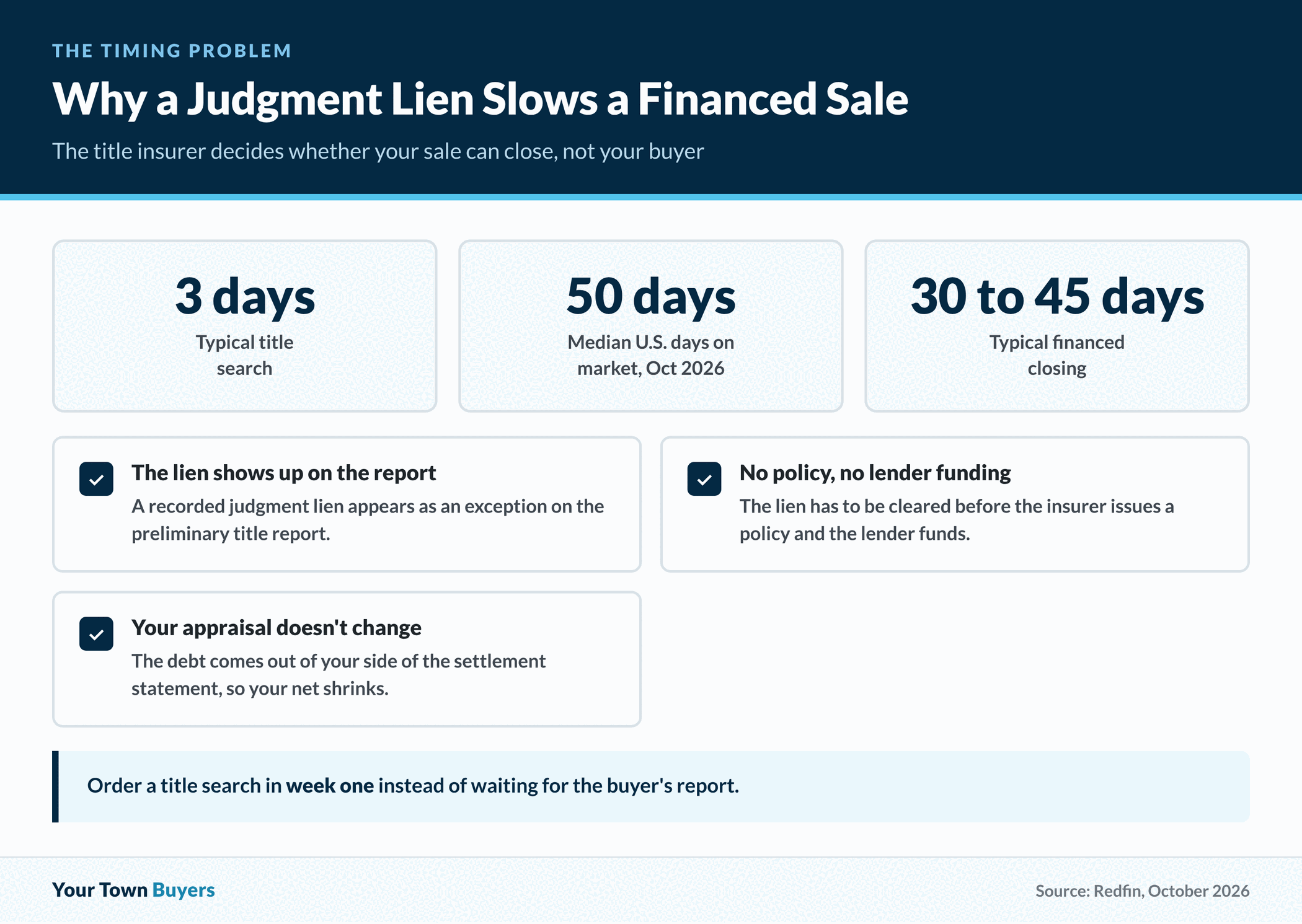
Your buyer isn’t the one who decides this. The title insurer is, and that’s the piece sellers find out too late.
A recorded lien shows up as an exception on the preliminary report, and once that judgment lien is disclosed on the report, it’s got to be cleared before you can close. Without clearing there’s no policy, and without a policy there’s no lender funding, so the chain breaks fast.
Timing is where the real pain lands. In October 2026 the median U.S. home sat 50 days on market before going under contract, according to Redfin’s national data, and that’s before the 30 to 45 days a financed closing usually eats. Add it up: you may be three months into a process when a lien surfaces and the whole thing stalls.
Most sellers wait for the title report to tell them what they already suspect, instead of ordering a search in week one.
Does having one lower what the house is worth? Not one cent. The house appraises the same. What changes is your net, since the debt comes out of your side of the settlement statement. Sellers with thin equity feel this hardest, especially now that prices have gone flat. Redfin measured the national median sale price at $388,634 in October 2026, down 0.35% from a year earlier, the first annual decline since 2023.
Can You Sell Your House with a Judgment Against You
“So am I stuck?”
No. You can sell, and most people in your position do exactly that, because the sale is what finally pays the thing off. The usual resolution is a payoff from escrow at closing, so the escrow officer pays the judgment balance out of your net proceeds. Payoff letters let escrow pay lienholders directly, which means you rarely bring money to the table.
Equity decides how smooth this goes. Short on equity and you’re in negotiation territory, which is doable but slower.
Early last year three siblings called me about their mother’s place after she’d moved into assisted living that spring. One sibling had a judgment against him from a failed business, recorded in the same county, and because his name was on the deed alongside hers, it attached to his fractional interest. We closed on a Thursday with his share of the proceeds paying the creditor and the other two walking away whole.
A judgment against you reaches only your ownership interest, not your co-owner’s, though it still has to be resolved before anyone gets clean title.
Here’s where I’ll disagree with common advice: plenty of articles tell you to pay off the judgment before you list. If you have the cash sitting there, fine. Most people don’t, and draining savings to clear a lien that escrow would have handled anyway leaves you cash-poor on moving day.
Can a Buyer Back Out Because of a Judgment Against You
Most purchase contracts give the seller a cure period. The buyer objects to a title defect, you get a defined number of days to fix it, and only if you fail does the buyer walk with their earnest money. That cure window’s in your contract, not in state law, and it’s negotiable before you sign.
Some buyers walk, though. Their lender gets nervous, their rate lock expires, their patience runs out. With 1,526,984 homes active nationwide in October 2026, roughly 2% more than a year earlier, a buyer who smells complication has plenty of other doors to knock on.
Conventional lenders won’t fund without clean, insurable title, so a court judgment puts their whole approval in limbo.
Cash buyers tolerate more. We’ve closed on properties where the lien math wasn’t finished yet, because we’re not waiting on an underwriter and we can work directly with the title company on an escrow holdback. A title company can hold funds from the sale to pay the judgment and omit the exception from the report, typically holding back an amount well above the judgment itself as a cushion. That flexibility is one reason local buyers like Your Town Buyers get calls from sellers whose listings fell apart over a title problem.
Buyers deserve to know early, so don’t sit on it. A seller who discloses a judgment against you upfront and shows a plan reads as organized. A seller who gets caught in week six reads as a risk, and buyers price risk by leaving.
How Do You Clear a Judgment Lien Before Closing
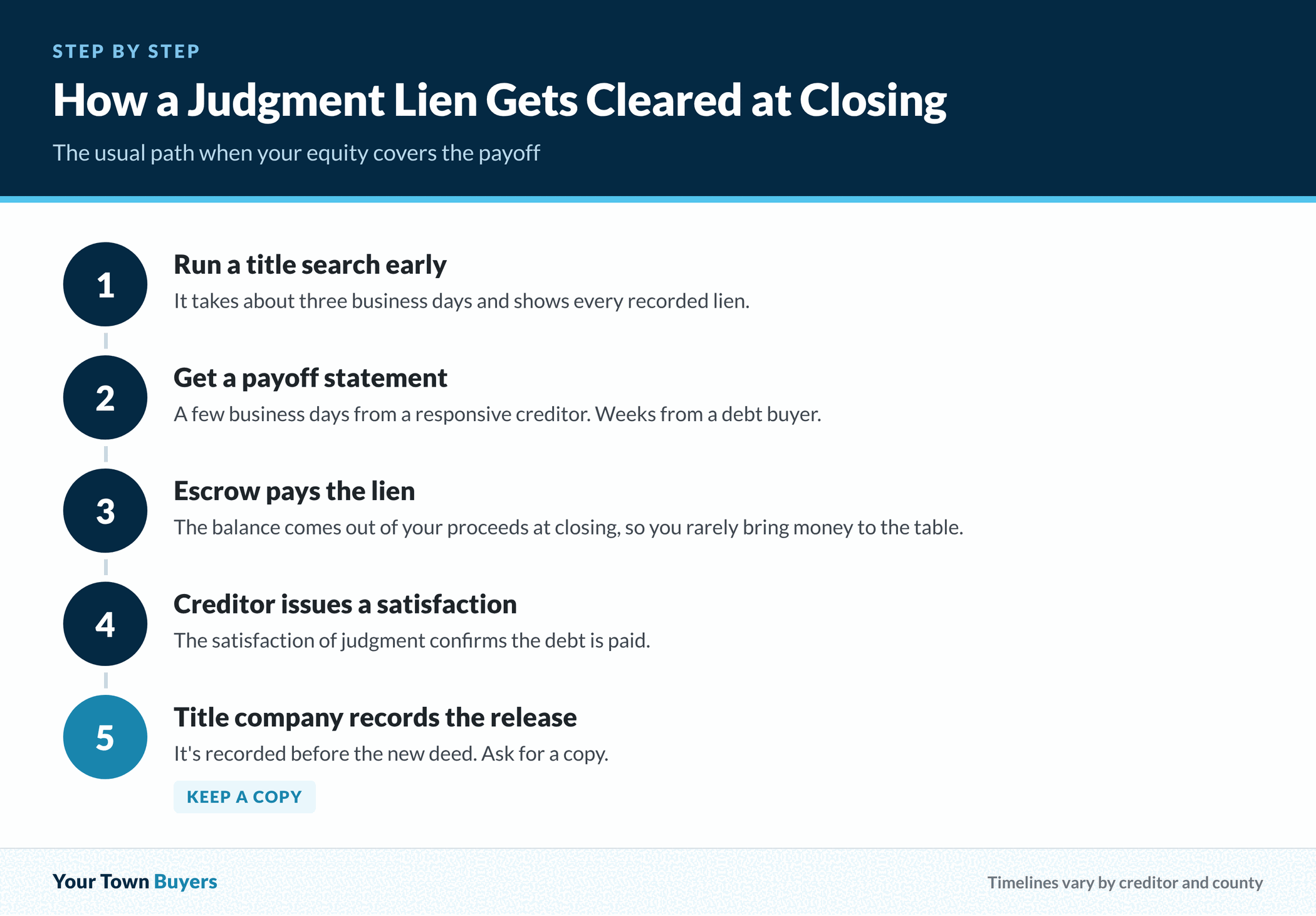
Which brings us to the mechanics, and they’re less mysterious than the phrase “clear title” makes them sound. A title company pulls a payoff statement from the creditor, pays the lien out of your proceeds at closing, and records the release, so the whole thing moves in a set order. The creditor issues a satisfaction of judgment once paid, and the title company records that satisfaction before recording the new deed.
Paying the creditor doesn’t scrub the county record by itself.
A lien that was paid years ago can still appear on county records if nobody ever filed the release, so the index keeps showing it open even after the debt is long gone. I’ve had sellers swear a debt was settled, and the index still showed it open because the satisfaction never got recorded. Ask your closer to confirm the recorded release and keep a copy.
Judgment creditors, especially debt buyers who bought your account for pennies, will often take less to get paid now because they’d rather collect something today than chase it for years. Your attorney can make that call on your behalf, and a reduced payoff is just more money staying in your pocket.
Three other paths exist when payoff isn’t realistic. When a lien is bigger than your equity, the fix is sometimes a negotiated or partial release, so you’re not stuck covering the full amount. A homestead exemption may shelter part of your equity from the creditor, depending on your state. And if the lien was recorded in error, against the wrong person, or after the judgment already expired, it can be challenged in court.
Don’t wait until you’re five days from closing to start any of this.
What Happens to Sale Proceeds When a Judgment Lien Exists
Picture the settlement statement you’re imagining: sale price, minus mortgage, minus commissions, and the rest wires to your account Friday afternoon. Add a judgment against you and a fourth line appears above yours, because liens get paid in recording order and your proceeds are what’s left after the recorded claims are satisfied.
A first mortgage recorded in 2019 outranks a judgment recorded in 2023, no matter which debt is larger.
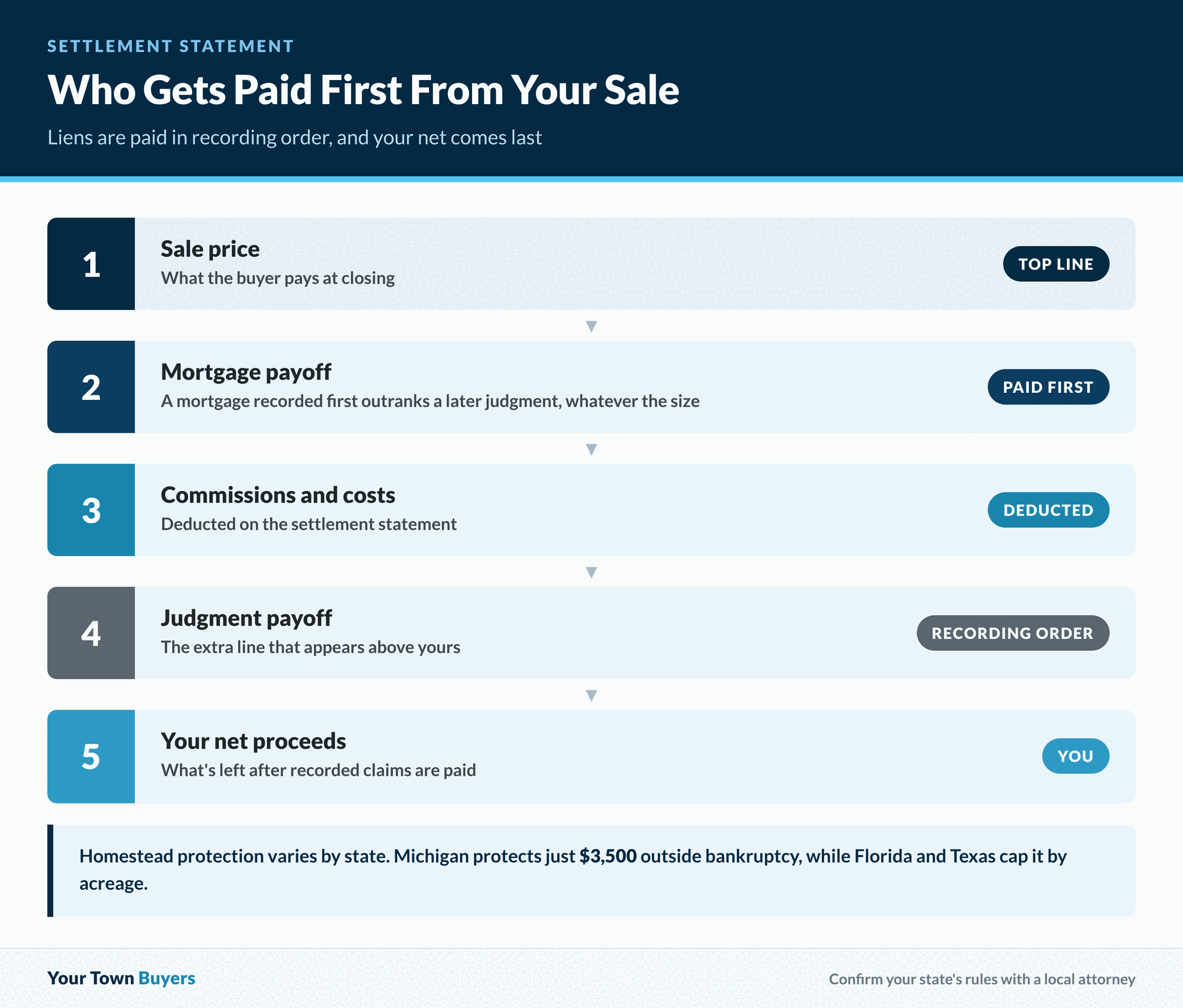
Homestead protection can change the arithmetic in your favor, and it varies more by state than almost anything else in real estate. New Jersey has no general homestead exemption shielding a home from creditors, Maryland and Pennsylvania offer none outside bankruptcy, and Michigan protects just $3,500 of value outside bankruptcy. At the other end, Florida and Texas cap protection by acreage rather than dollars. You can compare your state on this state-by-state breakdown, then confirm the current figure with a local attorney. Several states index these amounts annually, and I’ve seen closings stall when sellers assumed the wrong number.
Some states also protect your sale proceeds for a window after closing so you can reinvest in another home. Arizona shields them for a set period, for instance. Whether yours does, and for how long, is a question for counsel rather than a blog.
When the lien swallows every dollar of equity, selling can still beat holding. Interest keeps getting added to most judgment balances, and the debt doesn’t go away because you stayed put.
Questions to Ask Before Selling with a Judgment Against You
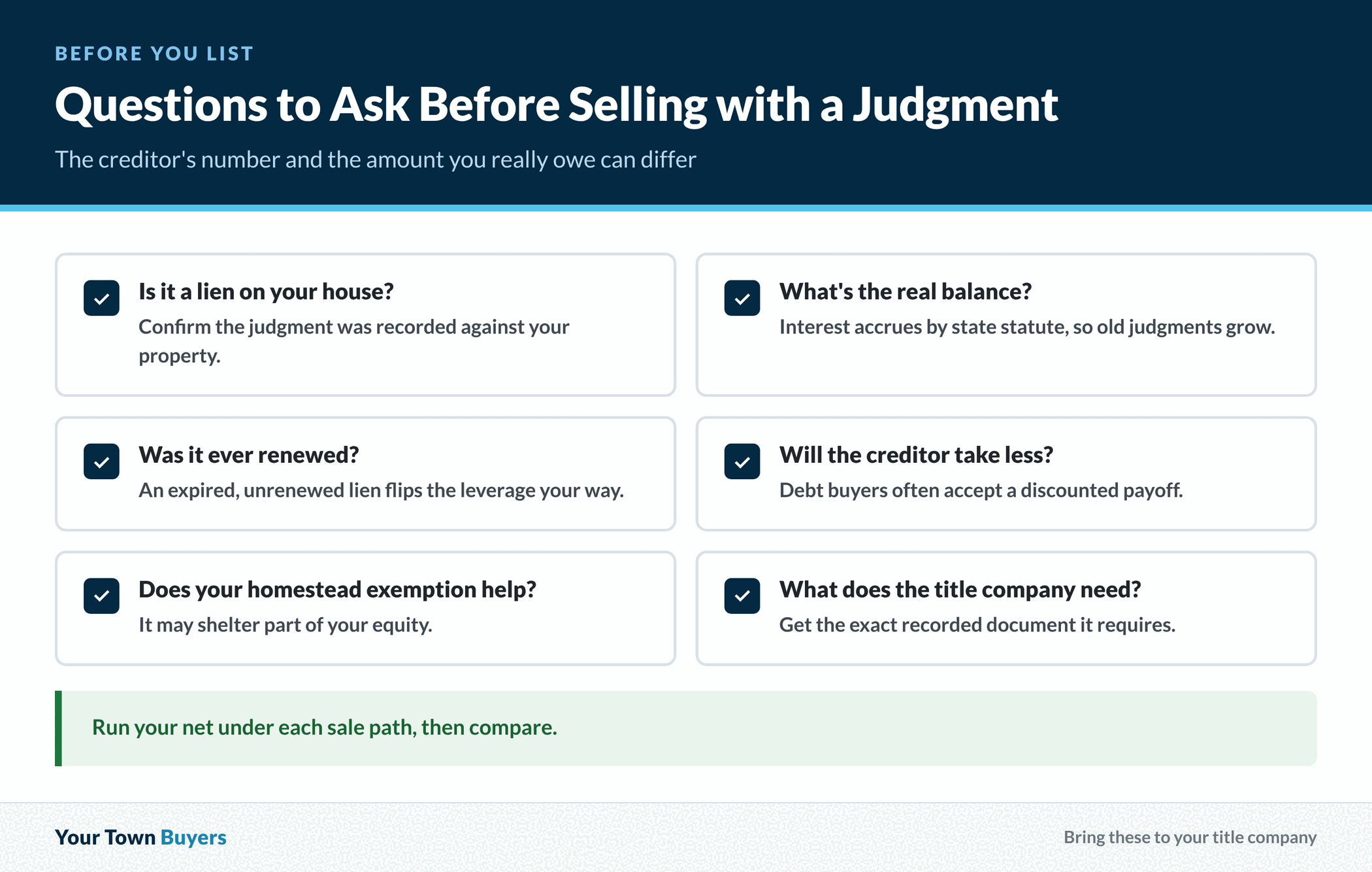
“If the creditor’s getting paid either way, why do I need to ask anybody anything?” The balance on the creditor’s letter and the balance you legitimately owe are frequently different numbers. Nobody at the closing table is paid to catch that for you.
Confirm the judgment created a lien against your property, then verify the balance, renewal status, equity position, and what the title company requires.
Judgment interest rates are set by state statute and accrue over time, so a decade-old judgment against you can be far larger than the original award.
Ask whether the judgment was ever renewed, and when. An expired, unrenewed lien still clouds title until somebody clears the record, but the leverage flips entirely in your favor.
Then the practical ones. Will this creditor accept a discounted payoff? Does my state’s homestead exemption cover any of my equity? What recorded document does the title company need in hand before it will insure? Sellers should ask the title or escrow company exactly what recorded document it needs before treating the lien as cleared.
One more, and it’s the one I’d push hardest. What does my net look like under each sale path? A retail listing at full price with months of carrying costs and commissions can net less than a quick as-is sale, or it can net more. Run both. Teams like Your Town Buyers will give you a number to compare against an agent’s estimate, and comparing beats guessing.
Why Hire a Real Estate Attorney for a Judgment Against You
A few hundred dollars for two hours of legal services is the cheapest insurance in this entire process. Judgment law is state law, and the gap between states is wide. New York, for example, keeps a money judgment enforceable for twenty years while the real estate lien itself runs only ten, per this analysis from a New York real estate firm. A lawyer who practices where your house sits knows which clock applies to you.
Things a title officer won’t do, a real estate attorney does. They negotiate the payoff, verify whether the lien is still enforceable, and assert your homestead exemption. They also file to vacate a judgment against you that was entered improperly. A title officer doesn’t advocate for you.
Bankruptcy counsel is worth a conversation too, if the debts stack beyond this one. Certain judgment liens can be stripped in bankruptcy where they impair an exemption, which is a decision that should never be made from a web article.
A homeowner reached me after two listings expired back to back. That was twelve months total and zero offers on a tidy three-bedroom with a detached shop out back. The second agent never ordered a title search, so a judgment against him from a business partnership had been sitting in the county index the whole time. Buyers’ lenders kept backing off and nobody told him why.
Twelve months of mortgage payments, insurance, and taxes burned over a problem that a $75 search and one phone call to an attorney would have surfaced in week one.
Frequently Asked Questions
Will a Judgment Against You Show Up on the Title Search?
If the creditor recorded it in the county where your property sits, yes. Title companies run a name search alongside the property search. That’s how old debts you’d stopped thinking about resurface. Unrecorded judgments won’t appear as liens on the property, though they can still be recorded later, so getting your own search done before you list is the smarter sequence.
Can the Creditor Force the Sale of My Home?
In many states a judgment creditor can initiate a forced sale, but it’s rare and expensive, and homestead protection often makes it pointless for them. Most creditors simply wait, since the lien gets paid whenever you sell or refinance. If you’ve received anything resembling a notice of execution or sheriff’s sale, that’s an immediate call to a lawyer rather than a wait-and-see situation.
What If the Lien Is Larger Than My Equity?
You have options, they’re just slower ones. Creditors regularly accept partial payoffs when the alternative is collecting nothing for years, and a short-sale-style negotiation with the lienholder is a normal part of this work. An attorney or an experienced local buyer who has worked through these can tell you within a call or two whether the numbers can be made to work.
How Long Does It Take to Clear a Judgment Lien at Closing?
Getting a payoff statement from a responsive creditor takes a few business days. Getting one from a debt buyer who changed hands twice can take weeks. Recording the satisfaction afterward adds more time, which is why escrow sometimes holds funds past the closing date. Plan for the long version and be pleasantly surprised by the short one.
Do I Have to Tell the Buyer About a Judgment Against You Before Accepting an Offer?
Disclosure rules differ by state, and a judgment against you is generally treated as a title matter rather than a property defect. Even where you’re not strictly required to volunteer it, telling the buyer early protects the transaction, since the title report will reveal it anyway. Sellers who get ahead of it keep their buyers; sellers who don’t tend to lose them in week six.
Can I Sell to a Cash Buyer If a Judgment Against You Is Still Unresolved?
Often yes, because a cash offer removes the lender from the equation and leaves only the title company’s requirements to satisfy. The lien still has to be paid or released before title transfers, but the timeline compresses and the process gets a lot less fragile. That’s the main reason sellers in this spot look at direct buyers after a listing stalls.
If you’re sitting with a judgment against you and trying to figure out what your house would actually net you, we’re happy to walk through the numbers with you. No pressure, no obligation, and no hard sell if a traditional listing turns out to be your better move. Reach out to Your Town Buyers when you’re ready to talk it through.
Judgments and the Memphis Market
Memphis prices have softened this year. Zillow put the typical Memphis home value at $151,794 at the end of September 2026, down 2.8% from a year earlier. A thinner equity cushion means a judgment lien takes a bigger bite out of what you walk away with.
Your Town Buyers looks at houses with title problems across the metro, and we buy houses in Memphis in any condition.
That includes the suburbs. If your home is in Germantown, TN, we buy there too.
The same goes for sellers in Collierville, TN and across the rest of the metro.
Talk Through Your Judgment Lien With Us
If a lien is standing between you and a sale, you don’t have to sort it out alone. Tell us about the house and the judgment, and we’ll walk you through what a cash offer could look like after the payoff. You can contact Your Town Buyers whenever you’re ready, or use the form below to get started.
Helpful Tennessee Blog Articles
- How to Sell a House Without a Realtor in Tennessee
- Selling a Probate House in Tennessee
- How to Sell a House with Delinquent Property Taxes in Tennessee
- How to Sell a House with a Mortgage in Tennessee
- Selling a House in Foreclosure in Tennessee
- Selling a House During Divorce in Tennessee
- How Long Does an Eviction Process Take in Tennessee
- Appraisal Required Repairs in Tennessee
- How Much Do Realtors Charge to Sell a House in Tennessee
- How to File a Quitclaim Deed in Tennessee
- How Much Does It Cost to Stage a House in Tennessee
- How to Sell a Tennessee House without Repairs
- How to Sell Your House and Relocate Out of State
- Required Paperwork for Selling an Inherited House in Tennessee
- Can an HOA Foreclose on Your Home

Get Your Cash Offer And Sell Your House Without An Agent Today
Fill out the quick form below or call us at (901) 675-8005 to get an offer on your house TODAY!
"*" indicates required fields